


About Bible Study Together
Starting a Bible reading plan is easy.
Finishing one is different.
Genesis moves quickly. Exodus has unforgettable stories. Then the reading becomes unfamiliar, the schedule starts slipping, and eventually the bookmark stays in the same place for a few weeks.
Bible Study Together was created with that struggle in mind.
The ministry wanted to develop something more helpful than a calendar telling you which chapters to read each day. Its approach reorganizes the journey through Scripture so biblical history becomes easier to follow while related passages appear near one another.
The result is a reading plan built around connection.
You don't just make your way through the Bible.
You begin seeing how its pieces belong together.
Put the Story Back Together
Reading the Bible from Genesis straight through to Revelation has an obvious advantage: you're following the canonical order.
But that order isn't always chronological.
The Psalms appear together in one book even though individual psalms arose during different periods of Israel's history. The prophets can feel detached from the kings, conflicts, and national crises surrounding their messages.
Bible Study Together's Chronological Cross-Reference Bible Reading Plan rearranges much of that material so readers can encounter it closer to its historical setting.
A psalm can appear around the events associated with it.
Prophetic writings can be read alongside the historical world in which the prophet spoke.
The four Gospels are connected so parallel accounts can be compared more naturally.
History begins providing context for poetry and prophecy rather than leaving each section isolated.
Then Connect the Old Testament With the New
Chronology is only half of what makes the plan distinctive.
Bible Study Together also intentionally connects related Old and New Testament passages.
While reading about Abraham offering Isaac in Genesis, for example, the plan can bring you into James where Abraham's actions are discussed.
The Day of Atonement in Leviticus can appear alongside material from Hebrews explaining Christ's fulfillment of the sacrificial system.
Those pairings encourage Scripture to illuminate Scripture.
An Old Testament institution that once seemed distant suddenly helps explain something about Jesus.
A New Testament writer quotes or alludes to an earlier passage, and instead of vaguely remembering it, you've recently read the context.
Slowly, the Bible starts looking less like dozens of disconnected books.
The threads become visible.
Keep the Daily Reading Manageable
A reading plan can be beautifully organized and still fail if people don't have time to follow it.
Bible Study Together designed its primary plan so the daily Scripture reading can generally be completed in less than ten minutes.
That gives a busy reader a realistic baseline.
Read the passage and continue with the day.
When more time is available, however, the experience can become much deeper.
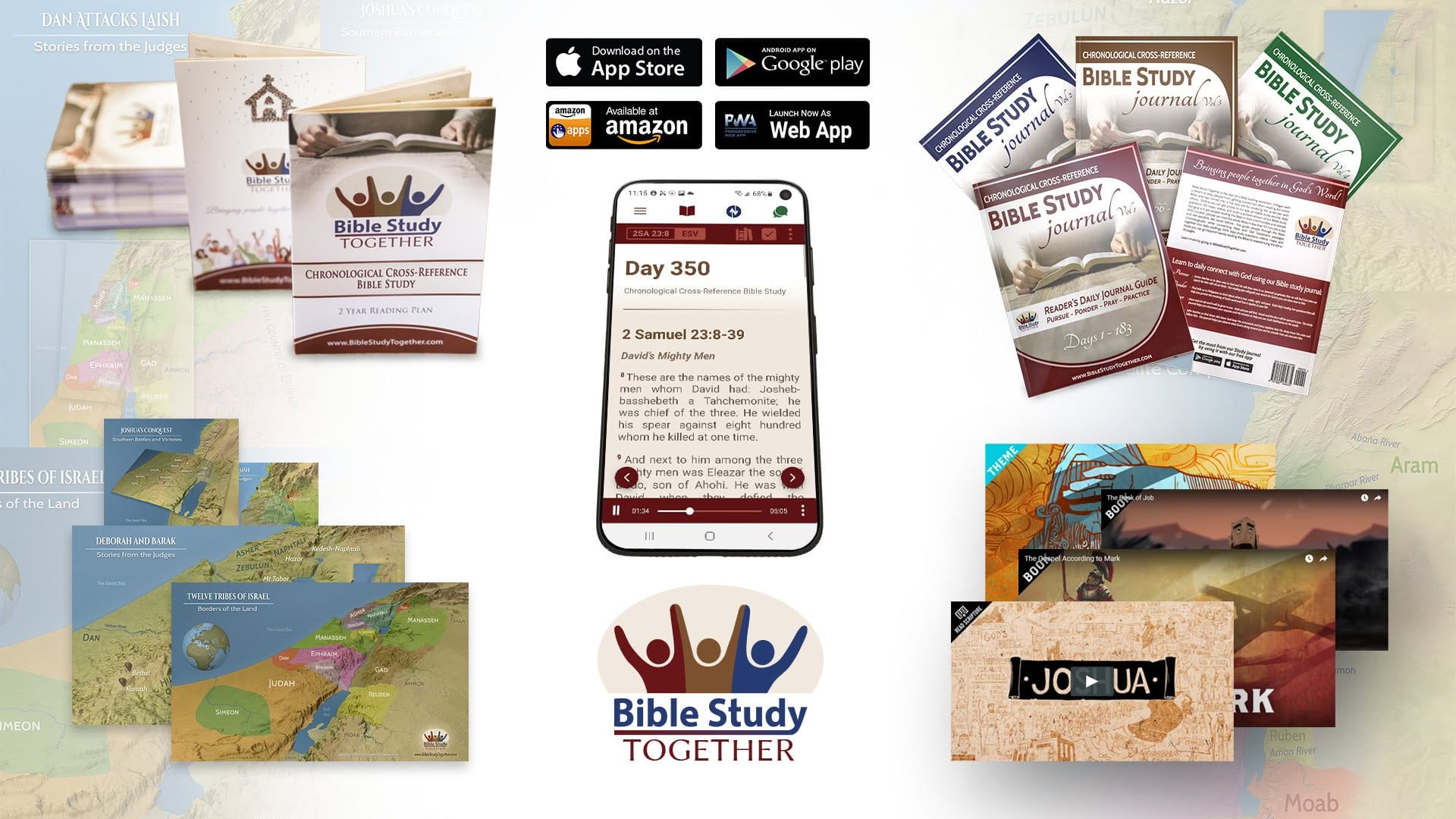
Daily open-ended questions encourage reflection rather than simple completion. Book introduction videos provide context, while hundreds of custom Bible maps help readers understand the geography surrounding biblical events.
Study journals create room for writing through what you're learning.
The basic commitment stays approachable without placing a ceiling on deeper study.
Don't Read the Whole Bible Alone
The word Together is just as important to the ministry as Bible Study.
Bible Study Together believes Scripture reading becomes more sustainable and meaningful when Christians do it in community.
Its app allows private groups to follow the same reading plan, stay connected, and share prayer requests.
A husband and wife could read together.
Friends could start the same schedule.
A small group can discuss what everyone encountered during the week, while a church can invite a larger portion of its congregation into a shared journey through Scripture.
Now the question isn't only, “Did I do today's reading?”
You're part of something.
Other people are moving through the same passages with you.
The next conversation already has common ground.
Prayer Belongs Beside Bible Reading
Bible Study Together doesn't treat prayer as a separate feature tucked into another application.
Prayer is built into the same environment as Scripture reading and fellowship.
Users can organize personal prayers, keep track of them, and share requests within their private groups.
A timed prayer feature can also help someone remain focused during intentional prayer sessions.
That combination reflects the ministry's broader idea of daily devotion.
Read what God has revealed.
Respond in prayer.
Carry the needs of other Christians with you.
Then return tomorrow.
Over time, those simple practices can form a rhythm.
The Phone Isn't the Only Way to Participate
Although its mobile app brings much of the system together, Bible Study Together hasn't designed the ministry exclusively around screens.
Some people simply prefer a printed Bible.
The ministry supports that preference with reading-plan booklets and Bible study journals. Its journals combine the daily schedule with study questions, writing space, and challenges, while printable resources allow groups to use the system without requiring everyone to study the same way.
Someone can listen through the app.
Another person can read digitally.
Someone else can sit at the kitchen table with a printed Bible, journal, and pen.
They're still traveling through the same plan.
Strengthen Real Christian Community
One of the most revealing things about Bible Study Together is what it doesn't try to become.
The ministry doesn't currently operate public online Bible study groups designed to connect strangers from around the world.
Instead, it encourages people to form groups within their own communities and become involved in local churches.
The technology is meant to support Christian fellowship rather than replace it.
That's an important distinction.
An app can remind you to pray.
It can display today's reading.
It can provide maps, questions, videos, and tools.
But Christian community ultimately involves people knowing one another.
Bible Study Together wants its technology to help those relationships gather around God's Word.
See One Story Instead of Sixty-Six Pieces
Perhaps the greatest payoff comes after months of reading.
The Psalms begin fitting into Israel's history.
The prophets aren't floating somewhere in the Old Testament anymore.
The Gospels can be compared more naturally.
Leviticus starts illuminating Hebrews.
Something encountered hundreds of pages earlier suddenly gives depth to what you're reading now.
The Bible hasn't changed.
Your ability to see its connections has.
And that's the kind of transformation Bible Study Together is trying to encourage.
Not racing through Scripture simply to say you finished.
Not checking boxes while missing the larger story.
But returning day after day, alongside other believers, until the many books and passages increasingly reveal the unified story running through them.
At the heart of Bible Study Together is the desire to help Christians move from wanting to read the whole Bible to actually understanding and finishing it. By weaving chronology, cross-references, prayer, study questions, maps, videos, printed resources, and private group fellowship into one experience, the ministry helps people see Scripture as a connected story—and gives families, friends, small groups, and churches a practical way to walk through that story together.


