


About the CSNTM
Long before the New Testament could be opened on a phone, purchased in a bookstore, or printed by the millions, it had to be copied by hand.
Scribes wrote the words of Matthew, John, Paul, Peter, and the other New Testament authors onto papyrus and parchment. Later scribes copied those manuscripts. Still others copied the copies. Some manuscripts traveled across countries and empires, while others eventually found homes in monasteries, churches, universities, museums, and private collections.
Many survived for centuries.
But none of them are indestructible.
Ink fades. Pages deteriorate. Bindings weaken. Libraries can suffer fires, wars, theft, natural disasters, or political instability. Some manuscripts remain difficult for scholars to access, while older photographic records may consist only of grainy black-and-white microfilm.
CSNTM exists because these documents preserve something too important to lose.
They are witnesses to the history of the New Testament text.
Preserve the Manuscript Before It Disappears
CSNTM was founded on September 13, 2002, by New Testament scholar Dr. Daniel B. Wallace.
Wallace recognized that digital photography was creating possibilities earlier generations of textual scholars did not have. Instead of relying primarily on microfilm or requiring scholars to travel repeatedly to distant libraries, manuscripts could be photographed at extraordinarily high resolution and preserved digitally.
CSNTM began pursuing an ambitious mission: use emerging technology to preserve and study Greek New Testament manuscripts.
That requires going where the manuscripts are.
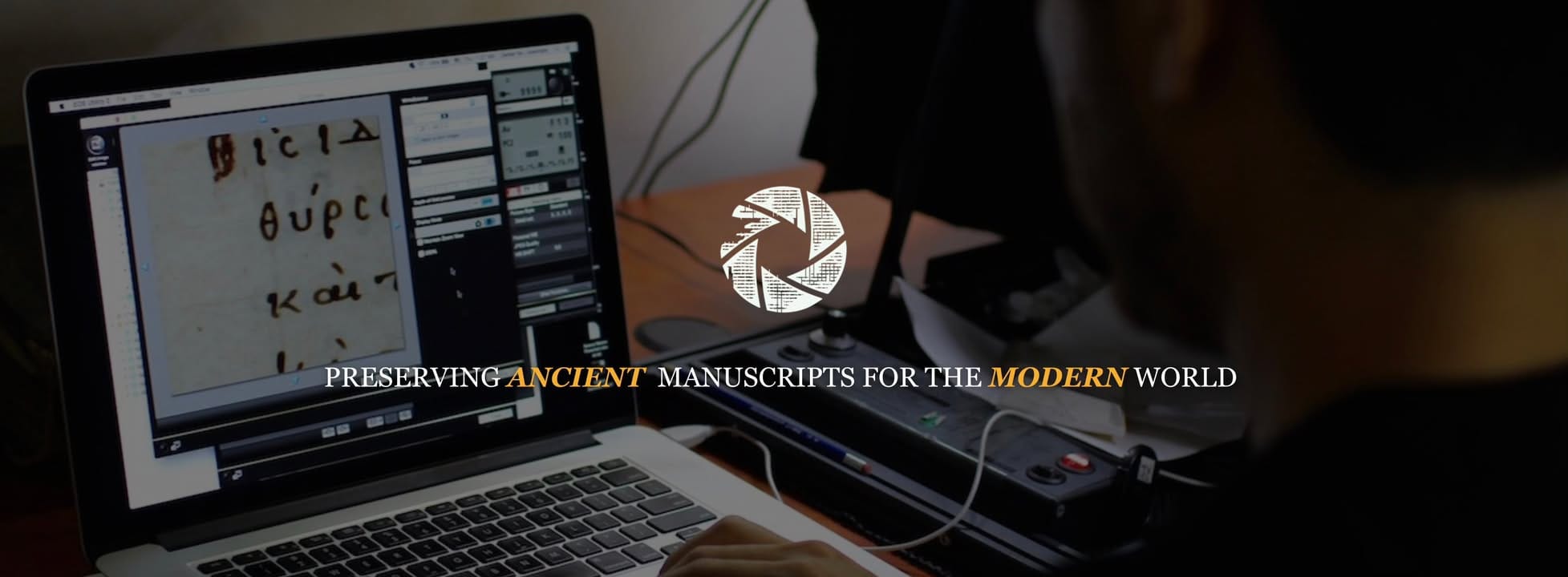
CSNTM teams have traveled to libraries, monasteries, universities, museums, archives, and other collections around the world. They work with the institutions that own the manuscripts, carefully examine the documents, photograph them, preserve the resulting data, and make many of the images accessible through an online collection.
The manuscript remains with its owner.
Its digital image can travel around the world.
A Photograph Can Preserve More Than Words
It might seem that preserving a manuscript simply means recording the words written on the page.
CSNTM is interested in much more.
A manuscript is a physical artifact.
Its size matters. Its binding matters. Its handwriting matters. Marginal notes matter. Decorations matter. Corrections matter. Changes in ink or scribal hands can matter. Even erased writing can contain information.
For that reason, CSNTM's teams carefully examine manuscripts before and during digitization.
Modern high-resolution photography can preserve tiny details that older microfilm technology struggled to capture accurately.
CSNTM's equipment has changed dramatically since its early years. CSNTM began with cameras producing images of only a few megapixels. More than two decades later, it has employed imaging systems capable of producing approximately 150-megapixel images.
That difference can reveal details that would otherwise be extremely difficult to study.
Find Writing That the Human Eye Can Barely See
Some manuscripts present an even greater challenge.
Parchment was valuable in the ancient and medieval worlds. Instead of throwing an old manuscript away, someone could scrape or wash the original writing from the page and reuse the material.
The resulting manuscript is called a palimpsest.
To the unaided eye, the earlier writing may be extremely faint or nearly invisible.
Modern multispectral imaging can sometimes recover it.
Instead of photographing a manuscript only under ordinary visible light, researchers capture images using different wavelengths. Writing that appears invisible under one condition can become distinguishable under another.
This means technology can sometimes recover textual information that has effectively been hidden for centuries.
CSNTM increasingly uses this kind of advanced imaging as part of its manuscript work.
Make the Manuscripts Available to Everyone
Preservation is only one part of CSNTM's mission.
Access matters too.
For much of the history of New Testament textual scholarship, studying a manuscript could require considerable money, travel, institutional permission, and time. Even then, a scholar might receive only limited access.
Digital preservation changes that equation.
CSNTM's Digital Manuscript Collection allows researchers to examine manuscript images remotely.
A professor can use them.
A doctoral student can use them.
A textual critic can use them.
A pastor studying the transmission of a passage can explore them.
An interested Christian who has never entered a manuscript library can see them.
The physical manuscript may sit thousands of miles away, but its digital image can be available from a computer.
CSNTM has deliberately treated accessibility as part of preservation.
The manuscripts are preserved so that they can be studied.
Textual Criticism Is About Comparing the Evidence
CSNTM's work belongs closely to the discipline known as New Testament textual criticism.
Because the original handwritten documents produced by the New Testament authors no longer survive, scholars study the manuscripts that do.
Those manuscripts contain variations.
A scribe might accidentally repeat a word.
Skip a line.
Reverse word order.
Misspell something.
Clarify wording.
Or introduce another change during copying.
The existence of textual variants isn't a modern discovery or something scholars try to hide. Comparing those differences is precisely how textual criticism works.
Scholars examine the manuscripts and other evidence to determine, as carefully as possible, the earliest recoverable form of the New Testament text.
Better manuscript evidence therefore gives scholars better information.
CSNTM contributes to that process by improving access to the manuscripts themselves.
The Work Eventually Reaches the Bible in Your Hands
The connection between photographing an ancient manuscript and reading a modern English Bible can seem distant.
It isn't.
Critical editions of the Greek New Testament are produced through careful study of surviving textual evidence. Scholars, professors, pastors, and Bible translators then work from editions of the Greek text.
The clearer and more accessible the manuscript evidence becomes, the better scholars can evaluate that textual history.
CSNTM therefore operates several steps behind what most Christians encounter.
It doesn't primarily translate Bibles.
It helps preserve and provide the evidence scholars use when studying the Greek text that stands behind Bible translation.
The work may happen quietly inside a library with cameras and manuscripts, but its significance can eventually reach ordinary Bible readers.
Sometimes Preservation Leads to Discovery
CSNTM teams have also discovered previously unknown New Testament manuscripts.
A manuscript may sit in a collection without having been properly identified or registered as a Greek New Testament witness. Careful examination can reveal what it actually contains.
Since its founding, CSNTM reports discovering almost 60 previously unknown manuscripts that subsequently entered the official catalog of Greek New Testament manuscripts.
Each discovery adds another piece of evidence to the history of the New Testament text.
Some manuscripts may contain large portions of Scripture.
Others may preserve only fragments.
Their importance is not determined simply by size. Their age, textual characteristics, provenance, contents, and relationship to other manuscripts can all make them useful for scholarship.
Collaboration Makes Preservation Possible
CSNTM cannot simply enter a library and begin photographing whatever it wants.
The manuscripts belong to other institutions.
That makes relationships essential.
CSNTM works collaboratively with manuscript owners, librarians, curators, scholars, universities, seminaries, and research institutions.
CSNTM reports having collaborated with more than forty institutions across four continents and having visited hundreds of institutions in more than 50 countries during its wider manuscript work.
The relationship is intended to benefit the manuscript owner as well.
After digitization, CSNTM provides the owning institution with archival copies of the images and associated metadata. The owner retains the rights to the images, while CSNTM seeks permission to make them available through its digital collection.
Preservation becomes a partnership rather than an acquisition.
An Expedition Can Take Years
Some projects are enormous.
At Oxford University's Bodleian Library, for example, CSNTM has been working with a collection containing at least 105 Greek New Testament manuscripts.
Before large-scale digitization could begin, the team examined the manuscripts individually, recording physical dimensions, leaf counts, contents, inserted material, decorations, marginal writing, and other relevant characteristics.
The project calls for producing more than 40,000 high-resolution page images while also identifying manuscripts that may benefit from multispectral imaging.
This illustrates what manuscript preservation actually requires.
It isn't simply taking pictures.
Each document must be handled carefully, documented accurately, photographed consistently, processed, backed up, indexed, archived, and prepared for research access.
Digital Preservation Requires Preservation of the Digital Files Too
Photographing the manuscript isn't the end of the process.
Digital files can also be lost.
Hard drives fail.
Formats become obsolete.
Servers can be damaged.
CSNTM therefore treats archiving as a major part of its work.
Images undergo quality-control and post-production processes before they are prepared for online presentation. CSNTM maintains redundant backups and stores archival data in multiple locations.
The goal is long-term preservation.
An image produced today should not merely help a scholar next week.
Ideally, it should remain useful to scholars generations from now, even if the physical manuscript deteriorates further.
Train the Next Generation of Scholars
Preserving manuscripts without people capable of studying them would solve only half the problem.
Education therefore forms another major part of CSNTM's mission.
CSNTM trains emerging scholars through internships, scholarships, academic supervision, research opportunities, conferences, and direct involvement in manuscript work.
Students can encounter textual criticism as something tangible rather than purely theoretical.
The manuscripts become real objects.
They have dimensions.
Texture.
Handwriting.
Corrections.
Marginalia.
Damage.
History.
A scholar trained to understand these physical witnesses is better equipped to participate in preserving and studying them in the future.
Bring Serious Scholarship to Ordinary Christians
CSNTM also recognizes that questions about the New Testament text do not remain inside universities.
Christians hear claims that the Bible has been corrupted.
They encounter social-media videos arguing that centuries of copying made the original wording unrecoverable.
They hear about manuscript variants and wonder whether those differences undermine confidence in Scripture.
CSNTM tries to make the evidence accessible enough that these conversations do not have to depend on slogans.
People can learn how manuscripts were copied.
They can understand what textual variants actually are.
They can see the manuscripts themselves.
They can learn how scholars compare the evidence.
CSNTM's educational work therefore overlaps naturally with apologetics, even though manuscript preservation and textual scholarship remain its central activities.
Its approach is evidence-oriented: preserve the documents, study them carefully, and let people examine what survives.
Gather the Scholars Who Study the Text
CSNTM also supports the scholarly community directly.
Its Text & Manuscript Conference brings international New Testament scholars together in Plano, Texas, for focused work on textual studies.
CSNTM collaborates on research projects, participates in scholarly conferences, publishes research, and develops tools that can improve manuscript study.
This matters because textual criticism is collaborative by nature.
No individual scholar can personally examine every surviving manuscript.
Progress depends upon institutions sharing data, researchers challenging one another's conclusions, new technologies revealing additional evidence, and younger scholars building upon the work of previous generations.
CSNTM tries to strengthen that scholarly ecosystem.
Preserve the Evidence for the Next Generation
The earliest Christians preserved the New Testament differently.
They copied it.
Later generations collected manuscripts.
Libraries protected them.
Scholars catalogued them.
Microfilm allowed another generation to record them.
Digital imaging has created a new opportunity.
CSNTM sees itself as participating in that long chain of preservation.
The technology is modern.
The responsibility is ancient.
A manuscript written hundreds or more than a thousand years ago has survived long enough to reach the present generation. CSNTM's task is to make sure its witness does not stop here.
At the heart of CSNTM is the conviction that the surviving handwritten witnesses to the New Testament should be preserved, studied, and made accessible for generations to come. Founded by Dr. Daniel B. Wallace in 2002, CSNTM combines New Testament textual scholarship with high-resolution photography, multispectral imaging, digital archiving, international collaboration, education, and manuscript discovery. Its teams travel to libraries and collections around the world to preserve manuscripts digitally while leaving the physical artifacts and their rights with their owners. Those images then give scholars unprecedented access to evidence used in studying the history of the Greek New Testament text. By preserving ancient manuscripts with modern technology, training future scholars, and opening manuscript collections to a much wider audience, CSNTM helps ensure that fragile documents from Christianity's past remain available to inform the Church and scholarship far into the future.


