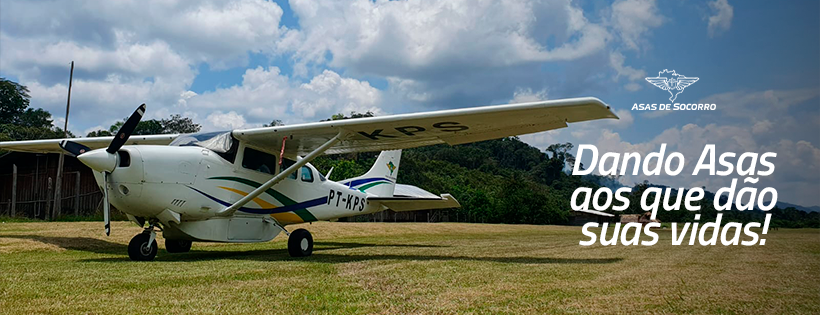
About Asas de Socorro
In the Amazon, sometimes the greatest obstacle between someone who needs help and someone who can provide it is simply getting there.
There may be no highway.
The nearest medical care might be hours away.
A missionary serving an isolated community may need supplies that can't arrive by truck.
A riverside village might need clean water, healthcare, education, or simply people willing to make the journey.
That's where Asas de Socorro comes in.
Its name means "Wings of Help" or "Wings of Relief."
And for decades, those wings have carried the love of God into some of Brazil's hardest-to-reach places.
When the Mission Field Doesn't Have Roads
Asas de Socorro is a Brazilian Christian missionary organization that has been serving remote communities since 1955.
Much of its work takes place throughout the Amazon.
That immediately creates an unusual challenge.
The Amazon is enormous, and many of the communities scattered throughout it are isolated from Brazil's conventional transportation infrastructure.
You can't always get there by car.
Sometimes you fly.
Other times you travel by river.
So Asas de Socorro built a ministry capable of doing both.
Its aircraft help transport missionaries and people serving remote communities. Boats extend that reach into nearby riverside areas.
Transportation becomes more than logistics.
It becomes a bridge between people who want to serve and people who might otherwise remain incredibly difficult to reach.
Carrying People, Not Just Cargo
It's easy to look at Asas de Socorro and see airplanes.
The ministry sees something else.
People.
An airplane can carry a missionary into an isolated region.
It can help transport healthcare workers or volunteers.
It can move supplies.
It can support Bible translators and other Christian ministries already serving in remote areas.
And in urgent situations, aviation can help connect people with medical assistance.
The aircraft matters because of who or what it allows to reach the other side.
That's why Asas describes its work as carrying love in the form of people.
The flight is only the beginning.
Serving the Whole Community
Once you arrive, another question appears.
What does this community actually need?
Asas de Socorro's answer has expanded far beyond aviation.
The organization develops longer-term projects with riverside communities while also organizing shorter missionary trips.
Teams can include people serving in healthcare and education alongside those working in social and environmental initiatives.
One important example is the ministry's work surrounding clean water.
In communities where safe drinking water isn't easily available, improving access to water can directly affect the health of families.
Other projects address needs affecting children and the wider community.
The approach is practical because love often becomes practical.
Sometimes serving someone means sharing Scripture and praying with them.
Sometimes it means helping their child receive care.
Sometimes it means making sure their family has clean water.
Asas de Socorro sees those things as belonging together.
Training the People Who Will Fly Next
Mission aviation requires more than a willing heart.
It requires serious preparation.
Flying into remote regions can involve demanding conditions that ordinary aviation training doesn't fully prepare someone to handle.
Pilots need skill.
Aircraft need careful maintenance.
Mechanics need specialized knowledge.
And safety matters tremendously when the people depending on you live far from conventional infrastructure.
That's why Asas de Socorro operates an aviation training center.
The ministry prepares pilots and aircraft mechanics for missionary aviation, helping develop people who can use highly technical abilities in service to Christ.
Someone who loves airplanes doesn't have to choose between aviation and missions.
Their cockpit can become part of the mission field.
So can their toolbox.
Helping Other Ministries Reach Their Calling
Asas de Socorro doesn't have to perform every ministry itself.
A significant part of its value comes from helping other ministries do what God has called them to do.
Bible translators need transportation.
Missionaries need access to communities.
Healthcare workers need a way to reach patients.
Christian organizations may need equipment moved into places conventional transportation can't easily reach.
Asas can become the connection.
Recent ministry updates, for example, describe flights supporting Bible translators and other missionaries while also highlighting cooperation with international mission-aviation organizations for specialized pilot training.
That spirit of partnership allows one aircraft to strengthen many different ministries.
The plane may belong to Asas de Socorro.
But the mission it enables can belong to the wider Body of Christ.
You Don't Have to Be a Pilot
There's also room for people who will never sit behind the controls of a missionary aircraft.
Volunteers can participate in missionary trips.
Professionals can use their abilities to serve communities.
Churches can partner with the work.
People can pray.
Others can financially support flights and projects.
Asas de Socorro describes its ministry as a community of missionaries, volunteers, and supporters.
Everyone isn't doing the same job.
They're helping move the same mission forward.
Taking God's Love to the Heart of the Amazon
For 70 years, Asas de Socorro has been finding ways to cross the distance.
Sometimes that happens several thousand feet above the rainforest.
Sometimes it happens along a river.
And sometimes it happens when a volunteer finally sits face-to-face with someone in a community that took hours to reach.
That's where all the aviation and logistics ultimately lead.
To people.
At the heart of Asas de Socorro is the conviction that isolation shouldn't determine who gets reached, served, or remembered. By putting airplanes, boats, professional skills, community development, and willing Christians into the service of God's mission, Asas helps carry practical care and the hope of Jesus into places where getting there is often the first—and one of the hardest—parts of serving.