About Aura
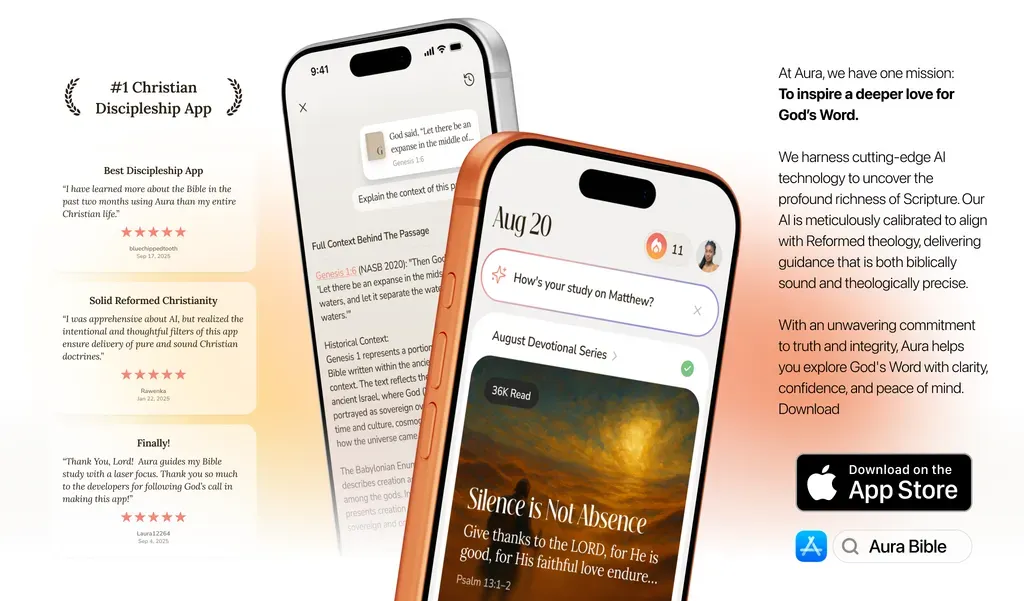
A Bible app can put Scripture on your phone. Aura wants to help you slow down long enough to actually engage with it. Built by a team of Christian designers, developers, and thinkers, Aura is an AI-powered Bible and prayer companion created to help people understand Scripture more deeply, develop a stronger prayer life, and grow closer to Christ. What makes the project unusual is the technology behind it. Aura uses artificial intelligence to personalize the experience, but it draws a deliberate boundary around what that technology is supposed to be: a tool serving God's Word, never something meant to replace Scripture, the Holy Spirit, trusted Christian leaders, or life within the local church.
Meeting People Where They're Already Looking
Questions about God don't always begin inside a church anymore.
Someone struggling with doubt might reach for their phone first.
A new Christian can open the Bible and quickly discover that understanding an ancient text isn't always easy.
Another believer wants to pray but doesn't know what to say.
Aura's creators see those moments as part of a modern mission field.
Inspired by Jesus' words about the plentiful harvest in Matthew 9, the team recognized that a generation accustomed to searching for answers online needed better ways to explore spiritual questions there too.
Instead of fighting that digital instinct, Aura tries to redirect it toward Scripture.
Making the Bible Easier to Explore
Aura isn't designed simply as another digital Bible reader.
The experience is built around helping someone understand what they're reading.
A person can encounter a difficult verse and explore its historical setting or theological meaning without leaving the passage behind.
Aura's Exegesis feature goes deeper into individual verses, while contextual study material helps readers understand how passages fit within the larger biblical story.
Cross-references make connections across Scripture easier to follow.
The idea is to remove some of the friction that causes people to close their Bible when they encounter something confusing.
Not to make Scripture shallow.
To help people go deeper.
What Happens When AI Enters Bible Study?
That's where Aura becomes particularly interesting.
Artificial intelligence can explain information remarkably quickly.
But should Christians trust it with theology?
Aura doesn't ignore that question.
Its AI is intentionally calibrated around Reformed Christian theology and the Westminster Confession of Faith. The platform says its system draws from more than 110,000 licensed ministry resources while being designed to keep its responses aligned with Scripture and historic Christian doctrine.
Even then, Aura doesn't present AI as a spiritual authority.
Users are encouraged to test what they receive against Scripture and seek wisdom from trusted church leaders.
The distinction matters.
AI can retrieve context.
It can organize information.
It can help explain a difficult concept.
But Aura openly acknowledges that an algorithm cannot illuminate Scripture in the way the Holy Spirit does.
Technology remains the servant.
God's Word remains the authority.
Learning How to Pray, Not Just What to Study
Sometimes the barrier isn't understanding Scripture.
It's knowing what to say to God.
Aura's prayer tools are designed for those moments.
Rather than simply generating a finished prayer for someone to repeat, its conversational approach can help users work through what they're trying to express.
Prayer requests can also become part of an ongoing spiritual record.
Over time, someone can look back and remember what they were praying about during a particular season.
That turns the phone into something more useful than another source of distraction.
It becomes a place to remember God's faithfulness.
A Personal Experience Without an Isolated Faith
Personalization is central to Aura.
The app can remember context from previous interactions so future conversations and devotional material become increasingly relevant to the person using it.
That creates an interesting possibility.
Bible study technology begins adapting to the individual rather than giving every person exactly the same experience.
But Aura also recognizes the danger.
Personalized Christianity can become isolated Christianity.
So the platform explicitly says it isn't intended to replace church fellowship or accountability.
Private study should ultimately strengthen someone's walk with Christ within the wider Body of Christ, not detach them from it.
Why Call It Aura?
The name comes from an image in Exodus 34.
After Moses spent time in God's presence on Mount Sinai, his face radiated when he came down.
He had encountered God, and something about that encounter became visible.
That's the picture behind Aura.
The goal isn't for people to spend more time with an app for its own sake.
It's for time spent engaging God's Word and seeking Him in prayer to shape the person who eventually puts the phone back in their pocket.
They read differently.
They pray more deeply.
They understand Scripture more clearly.
And ideally, their everyday life increasingly reflects the Christ they're encountering.
At the heart of Aura is an attempt to answer a distinctly modern question: can the technology competing for our attention become a tool that redirects our attention toward God? By combining contextual Bible study, guided prayer, and carefully bounded artificial intelligence, Aura seeks to meet people in the digital world without making the digital world the destination—helping them move beyond simply opening a Bible app toward knowing Scripture, seeking Christ, and carrying what they've learned into everyday life.