


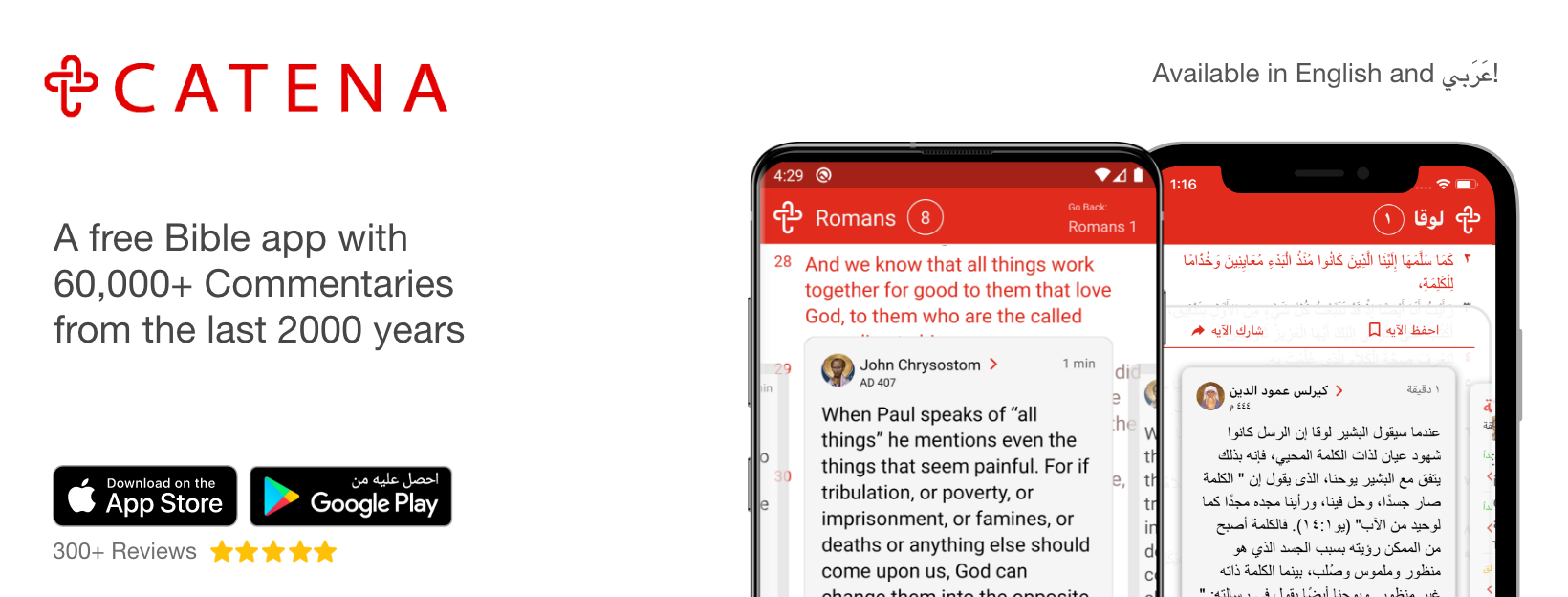
About Catena Bible
You open the Bible.
Read a verse.
And stop.
What exactly does that mean?
Today, the next step is often a search engine, a study Bible note, a YouTube video, or the interpretation of whichever teacher happens to appear first.
Catena Bible offers another possibility.
Ask Christians who wrestled with the same passage centuries ago.
What did John Chrysostom see here?
How did Augustine understand it?
What did Cyril of Alexandria teach?
Did Athanasius ever reference this passage?
What did Christians living much closer to the apostolic age believe these words meant?
Suddenly, reading the Bible becomes a conversation across centuries.
Put the Fathers Beside the Bible
The basic idea behind Catena is surprisingly simple.
Read Scripture.
Select a verse.
See what the Church Fathers said about it.
Instead of separating the biblical text from an enormous library of ancient Christian writings, Catena connects them.
A passage from Matthew can lead into Chrysostom.
John can lead into Cyril of Alexandria.
A theological question might introduce Athanasius, Augustine, Jerome, Origen, Gregory of Nyssa, Ambrose, Cyril of Jerusalem, or another influential Christian writer.
The commentary isn't hidden inside a specialist academic database.
It's attached to the verse.
That small design decision changes how accessible the early Church becomes.
“Catena” Means a Chain
The name itself comes from an ancient Christian tradition.
A catena is a chain of biblical commentary assembled from the writings of earlier Christian interpreters.
Imagine reading a verse followed by extracts from several Church Fathers explaining it.
One Father's thought follows another.
Commentary becomes a chain.
Catena Bible brings that old concept into a digital environment.
Instead of turning pages through enormous collections of patristic literature, a reader can move directly from Scripture into relevant commentary.
Ancient method.
Modern interface.
Recover a Library Most Christians Never Read
Names like Augustine and Athanasius are familiar to many Christians.
Their actual writings are less familiar.
The same is true of John Chrysostom, Cyril of Alexandria, Basil the Great, Gregory Nazianzen, Gregory of Nyssa, Ephrem the Syrian, Ambrose, Jerome, and the Apostolic Fathers.
The problem isn't necessarily lack of interest.
Access can be intimidating.
Where do you begin?
Which Father wrote about the passage you're studying?
Which work should you open?
How do you navigate hundreds of writings produced across different centuries?
Catena lowers that barrier.
You don't necessarily have to know which ancient book you need.
Start with the Bible verse.
Let the verse lead you into the library.
Don't Reduce the Fathers to Quotations
Catena has also grown beyond isolated excerpts.
A short quotation can tell you what a Christian writer said.
It doesn't always tell you why he said it.
Context matters.
The surrounding argument matters.
The rest of the sermon matters.
So Catena's expanding library includes complete works that can be read chapter by chapter.
That means someone who encounters Augustine through a verse can continue into a larger work.
A quotation from Athanasius can become an invitation to read On the Incarnation.
A passage from Chrysostom can lead into an entire homily.
The Bible commentary becomes a doorway into patristics.
Let Scripture Connect the Library
The relationship also works in reverse.
While reading a Church Father, biblical references can lead back into Scripture.
That creates a connected reading environment.
Bible.
Commentary.
Original work.
Back to Bible.
The pieces begin speaking to one another.
For serious students of early Christianity, this is especially valuable because the Fathers themselves constantly interacted with Scripture.
Their theology wasn't normally developed in isolation from biblical texts.
They preached Scripture.
Argued from Scripture.
Prayed Scripture.
Used Scripture in doctrinal controversies.
Catena allows modern readers to begin seeing those connections.
Remember That Christianity Didn't Begin Yesterday
Underneath the technology is a theological conviction.
Catena's founders believe the historic Christian faith was delivered through Christ and the apostles and preserved within the life of the early Church.
That explains the ministry's strong emphasis on patristic interpretation.
Modern Christians aren't the first people to encounter difficult biblical passages.
Christians debated Christology long before modern denominational arguments.
They wrestled with the Trinity.
Grace.
Free will.
Baptism.
The Eucharist.
Prayer.
Salvation.
Church authority.
Christian ethics.
Suffering.
The Christian life.
Returning to their writings doesn't automatically settle every modern disagreement.
But it gives today's Christian something invaluable:
historical memory.
Born From Coptic Orthodox Christians, Built for More Than Copts
Catena's origins matter.
The project began in Ontario, Canada, in 2015, created by a group of Coptic Orthodox Christians who wanted to deepen their own relationship with God.
That background helps explain its emphasis on apostolic Christianity and the Church Fathers.
But Catena doesn't describe its mission as serving only Coptic Orthodox Christians.
Its stated mission is much broader:
to evangelize the timeless faith of the Early Christian Church for the edification of Christians around the world.
Its library consequently crosses geographic traditions.
Eastern writers appear.
Western writers appear.
Alexandrian Christianity appears.
Antiochene Christianity appears.
Latin Christianity appears.
Syriac voices appear.
The result gives readers a window into a Christian world much larger than one modern denomination.
Carry Hundreds of Fathers in Your Pocket
What once required shelves of books can now travel on a phone.
That matters.
A Christian reading during lunch can access patristic commentary.
A student preparing a Bible study can compare interpretations.
Someone hearing a controversial interpretation can investigate how earlier Christians approached the passage.
A pastor can quickly locate historical commentary.
A person completely new to the Fathers can encounter one without knowing where to begin.
Catena is available through the web and mobile apps, turning what was once a specialized research task into something that can happen during ordinary Bible reading.
Accessibility becomes part of the ministry.
Go Beyond Commentary
Catena has gradually become more than a verse-commentary tool.
Its library now brings together Fathers and their complete works, sayings from the desert tradition, and daily readings.
Its media section connects biblical passages with sermons, talks, Bible studies, and other Christian teaching.
Thousands of videos can be explored in connection with Scripture.
Bible-reading tools have also expanded over time.
The result is increasingly a digital environment for exploring Scripture through the memory of historic Christianity rather than simply an app containing commentary notes.
Build It With Christian Laborers
Catena's story is also unusual because the ministry emphasizes the people behind the platform very little.
Its official description refers instead to Christian “laborers.”
Engineers.
Designers.
Editors.
Servants.
People scattered across the world contributing their skills and free time.
The emphasis isn't on turning the developers into personalities.
It is on building something useful for Christians.
Technology becomes an act of service.
A programmer can serve the Church through code.
A designer can make ancient Christian literature easier to navigate.
An editor can connect a centuries-old text with the biblical passage it discusses.
A translator can make another Father's voice accessible.
Digital work becomes ministry.
Translate What Is Still Hidden
There is also an enormous amount of early Christian literature that remains difficult for ordinary readers to access.
Some texts aren't translated into modern languages.
Others exist in old translations.
Still others remain buried in specialized collections.
Catena says donations help it license and translate additional commentary.
That makes the long-term vision considerably larger than collecting quotations already available online.
Every newly accessible text potentially adds another historical Christian voice to the conversation.
The digital library can keep growing.
Read Scripture With a Longer Memory
Catena doesn't remove the responsibility to study carefully.
The Fathers sometimes disagree.
Not every ancient interpretation carries equal weight.
Historical context still matters.
Translations still matter.
Biblical languages still matter.
And an early date doesn't automatically make every interpretation correct.
But Catena changes the starting assumption.
Instead of approaching Scripture as though nobody seriously interpreted it until our generation, the reader enters a conversation already nearly two thousand years old.
You can listen.
Compare.
Investigate.
Follow the references.
Read the larger work.
Return to Scripture.
And discover how Christians from another century heard the same words sitting on your screen today.
At the heart of Catena Bible is a desire to reconnect Scripture with the historical memory of Christianity. Founded by Coptic Orthodox Christians in Canada in 2015, Catena uses modern technology to place the writings of the Church Fathers directly beside the biblical passages they interpreted. What once required specialized libraries and knowledge of patristic collections can now begin with something as simple as tapping a verse. From there, Augustine, Athanasius, Chrysostom, Cyril, Jerome, the Gregories, the desert tradition, and hundreds of other Christian voices enter the conversation. Catena's technology may be modern, but its instinct is ancient: Christians shouldn't have to read the Bible as though the Church began with their own generation.


