


About Bible Analyzer
Opening a Bible is simple.
Studying everything connected to a passage can become complicated very quickly.
You notice a word you want to investigate. That leads to another verse. A commentary mentions something you hadn't considered, so you reach for a dictionary. Then you want to compare translations, examine the original language, check cross-references, and save everything you've discovered for later.
Before long, the desk can disappear beneath books.
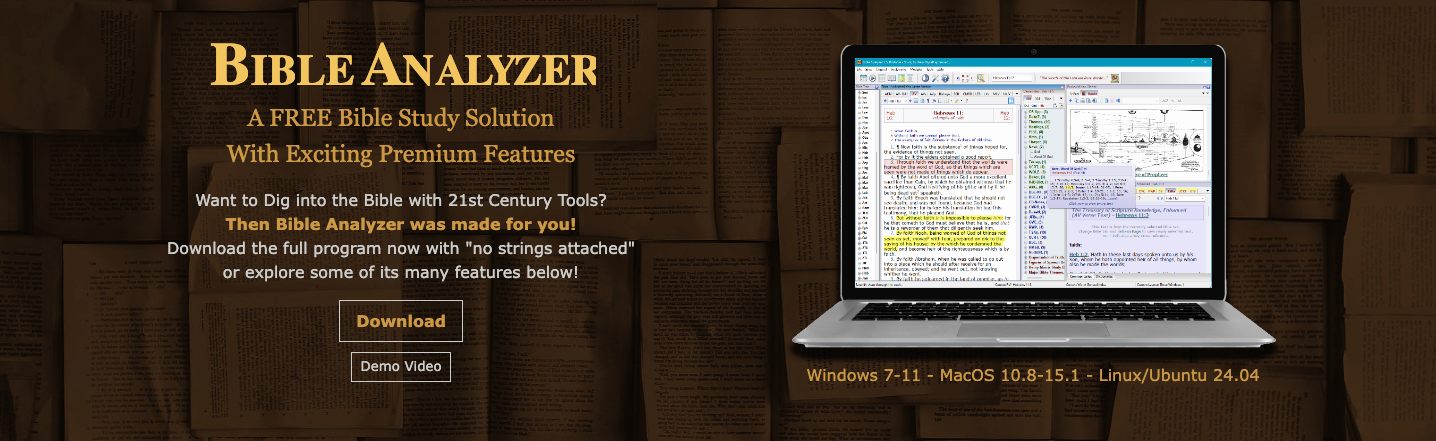
Bible Analyzer brings much of that study environment onto one screen.
Developed by Timothy S. Morton, Bible Analyzer is free Bible study and analysis software designed to help Christians move easily between Scripture and the resources that help them examine it more deeply.
But there's an important philosophy behind the software.
Its creator doesn't simply describe Bible Analyzer as a product.
He describes it as a ministry.
Serious Bible Study Shouldn't Depend on Your Budget
Bible software can become expensive.
A sophisticated program may be free to download while many of the resources that make it genuinely useful sit behind subscriptions or large library purchases.
Bible Analyzer deliberately takes another approach.
The complete program is available free of charge without a limited trial, feature restrictions, nag screens, or usage tracking. Users also gain access to more than 100 free titles.
That decision reflects the purpose behind the project.
Bible Analyzer's developer wants people to have access to capable Bible study software regardless of their financial situation.
Premium resources are available for those who want to expand their libraries, and those purchases help support the work.
But paying isn't required to turn the program into a serious study environment.
You can simply download it and begin studying.
Search Scripture Differently
Searching for a word in the Bible sounds straightforward until the question you're asking becomes more complicated.
Bible Analyzer goes considerably beyond a basic keyword box.
Its advanced tools allow users to examine relationships between words and passages, search within particular contexts, investigate related verses, search an entire library, and even perform sophisticated searches using regular expressions.
One of its more unusual features is the Advanced Concept Filter.
Instead of limiting a study entirely to one exact word, concepts can be represented by groups of related biblical terms.
That opens the door to questions that ordinary word searches struggle to answer.
The software also includes specialized resources where biblical people are individually tagged. When Scripture contains several people with the same name, those identities can be distinguished rather than automatically treated as the same person.
The computer becomes useful not because it interprets Scripture for you, but because it can notice patterns across thousands of verses faster than a person flipping through pages.
Let the Library Follow the Verse
One of Bible Analyzer's most practical ideas appears when you click a passage.
The rest of your library can follow you there.
Its Reference Panel identifies loaded resources that discuss the verse you're currently studying. Commentaries can update alongside the biblical text, while cross-references remain close at hand.
That changes how a digital library feels.
Instead of remembering which book might mention Romans 5:1 and manually searching each resource, Bible Analyzer can help surface material connected with the passage.
Your books become less like separate volumes sitting on shelves and more like an interconnected study library built around Scripture.
Look Beneath the English Text
Readers wanting to explore biblical Hebrew and Greek can go deeper.
Bible Analyzer supports original-language study through tools such as its stacked interlinear display. Depending on the installed resources, information connected with an original word can include Strong's numbers, morphology, and other linguistic data.
Its AV/Strong Indexer can approach the relationship from the English side.
Enter an English word and the program can identify the Hebrew or Greek words translated by it.
This can reveal something easy to miss when reading only one translation.
The same English word doesn't necessarily represent the same original word every time it appears.
And the same Hebrew or Greek word may be translated differently depending on context.
Bible Analyzer gives curious readers a pathway into those relationships without requiring them to begin as professional biblical-language scholars.
Build the Study While You're Studying
Research eventually needs somewhere to go.
Bible Analyzer includes ScripturePad, an integrated editor where users can develop lessons, sermon material, or personal studies while working inside the program.
Bible references can become interactive links.
Verses can be moved directly into notes.
Personal notes can also be attached to a verse, chapter, or biblical book, allowing someone's own study to gradually become connected with the text.
Over time, Bible Analyzer can become more than the software originally downloaded.
It becomes a personal study environment shaped by years of reading, observations, research, and preparation.
Add the Books You Actually Need
Not every student of Scripture needs the same library.
Bible Analyzer therefore uses modules.
Bibles, commentaries, dictionaries, books, devotionals, charts, images, and specialized study resources can be added through its built-in Download Manager.
Many are free.
Others are inexpensive premium resources that help fund continued development.
This modular approach allows a user to build outward gradually rather than purchasing an enormous collection before knowing what will actually be useful.
A pastor preparing sermons may build one kind of library.
Someone studying biblical languages may create another.
A Christian primarily interested in devotional reading can keep things considerably simpler.
The program grows with the study.
Technology Should Point Back to the Text
Bible software can provide an extraordinary amount of information.
But information isn't supposed to become the destination.
Bible Analyzer continually organizes its tools around the biblical text itself.
The Bible remains open while commentaries provide perspective. Dictionaries clarify terms without replacing the passage. Search tools reveal connections that send the reader back into Scripture.
Even the more technical features ultimately serve a very old practice:
Opening the Bible and paying careful attention to what it says.
Modern computing simply allows that investigation to happen at a scale previous generations couldn't have imagined.
A concordance search that once required slowly scanning pages can happen almost instantly.
Hundreds of books can be searched together.
Parallel passages can sit beside each other while original-language information remains only a click away.
The technology is modern.
The purpose behind it isn't.
At the heart of Bible Analyzer is a desire to give Christians powerful tools for examining Scripture without making serious Bible study dependent on someone's ability to purchase expensive software. By combining the biblical text with searching, cross-references, original-language tools, commentaries, personal notes, and an expandable library, Bible Analyzer turns a computer into a digital study desk—while keeping the Bible itself at the center of everything happening on the screen.


