


About Bibles for the Blind
Place an ordinary printed Bible beside its Braille equivalent and the difference is striking.
The printed Bible might fit comfortably in one hand.
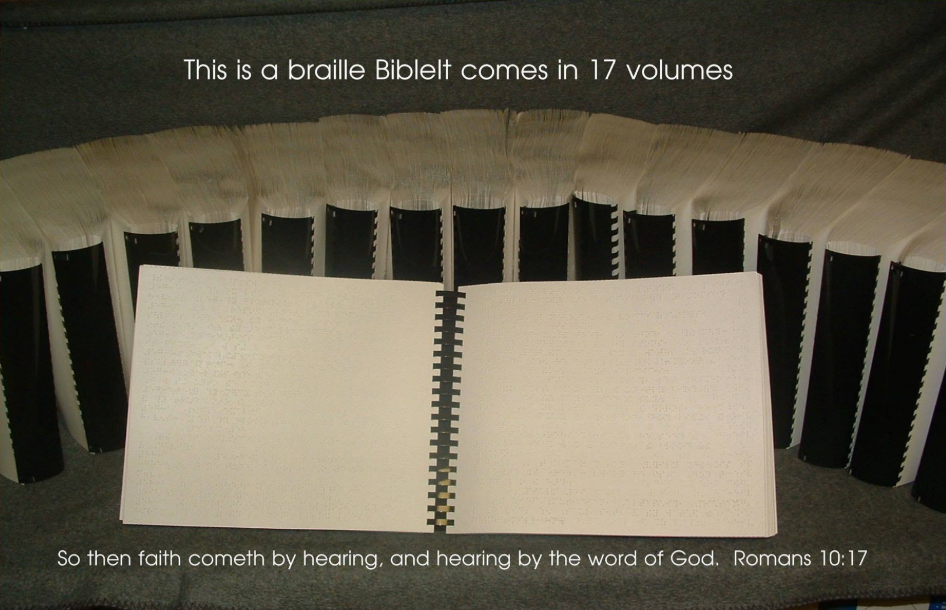
A complete King James Bible in Braille can fill seventeen large volumes.
Each volume is roughly the thickness of a standard Bible and measures around eleven inches tall and eleven-and-a-half inches wide.
Now imagine purchasing the entire set.
Then imagine needing that format simply because it's the only way you can personally read the words on the page.
Bibles for the Blind and Visually Handicapped International exists for Christians facing exactly that barrier.
The ministry prints and distributes Braille Scripture without charge to blind and visually impaired people who otherwise could not afford it.
Its purpose isn't merely to make the Bible available.
It's to make the Bible readable.
Reading With Your Hands Changes the Book
Braille turns written language into patterns of raised dots that can be recognized by touch.
A reader moves their fingers across those patterns and reads much as a sighted person follows printed letters across a page.
But Braille takes considerably more physical space than ordinary print.
That's why a Bible that fits into a backpack in print can become an entire collection of volumes in Braille.
It also makes production expensive.
Bibles for the Blind explains that a retail Braille King James Bible can cost hundreds of dollars.
For someone living on a limited income, that can put personal access to a readable Bible far out of reach.
The ministry removes the price from the recipient.
If someone qualifies for its assistance, the goal is to provide Scripture without requiring that person to overcome another financial barrier first.
Listening and Reading Aren't Quite the Same
An obvious question follows.
Why produce seventeen volumes when an entire audio Bible can fit on a tiny digital device?
Because listening and studying aren't always the same experience.
Audio Scripture is enormously valuable, and the ministry recognizes that.
But imagine trying to investigate one sentence carefully when you can't see where the comma falls.
Or trying to compare two verses while repeatedly navigating backward and forward through an audio recording.
A Braille Bible gives a reader direct control over the text.
Their fingers can stop.
Move backward.
Return to a word.
Examine punctuation.
Locate a passage and remain there.
For someone preparing a Bible lesson, studying doctrine, memorizing Scripture, or simply wanting to meditate slowly on a verse, that independence matters.
The blind Christian isn't limited to hearing someone else read Scripture.
They can read it themselves.
Let Technology Make Braille More Accessible
Producing Braille once required much more cumbersome processes.
Computerized Braille printing changed what became possible.
Bibles for the Blind uses Braille embossing technology to transform digital Bible files into raised-dot pages. Those pages can then be assembled into the large volumes required for a complete physical Bible.
Technology has opened another door as well.
Not every Braille reader needs hard-copy volumes.
Electronic Braille displays and specialized notetakers allow digital files to be converted into tactile Braille beneath a reader's fingers.
Bibles for the Blind makes its Braille Ready Files available for free download.
A resource that once required shelves of paper can therefore travel inside an electronic device.
The format changes.
The ability to personally read Scripture remains.
Send Scripture Where the Need Appears
Finding people who need accessible Scripture requires relationships.
Requests and referrals can come through churches, prisons, nursing homes, rehabilitation centers, Braille libraries, and other organizations serving blind and visually impaired people.
The ministry has distributed Scripture across the United States and internationally.
That can put a Braille Bible into very different settings.
One reader may use it during personal devotions at home.
Another might be incarcerated.
Someone living in a nursing facility may want Scripture they can independently return to every morning.
A Christian involved in ministry may need a readable Bible for teaching others.
Their circumstances differ.
Their need is remarkably similar.
They want access to the same Word of God sighted Christians can simply pull from a shelf.
Christian Resources Shouldn't Stop With the Bible
Spiritual growth doesn't end after someone receives Scripture.
Sighted Christians have access to enormous libraries of devotionals, hymnals, Bible studies, theological books, tracts, and discipleship materials.
Blind Christians need those resources too.
Bibles for the Blind has therefore made additional Christian materials available in accessible formats.
That includes Braille Gospel tracts and resources such as Oswald Chambers' My Utmost for His Highest. The ministry has also offered a Braille hymnal and directs readers toward other organizations providing accessible Christian resources.
Evangelism is included as well.
Some Gospel tracts are available in Braille, while tactile Wordless Book bracelets use differently shaped beads so the Gospel presentation can be used by people who are blind or have low vision.
Accessibility becomes part of discipleship, worship, and evangelism rather than a separate concern.
See the Person Before the Disability
There's another section of the ministry's website that says something important about its philosophy.
It's written for sighted people.
The guidance explains ordinary ways of interacting respectfully with someone who is blind—speak directly to the person instead of speaking through someone accompanying them, don't assume help is needed without asking, and don't reduce an entire person to their blindness.
The message underneath those practical suggestions is simple.
Blindness describes something about a person.
It doesn't describe the whole person.
That same principle belongs in Christian ministry.
A blind Christian isn't merely someone receiving specialized assistance.
They are a member of Christ's body.
They can study Scripture.
Teach.
Pray.
Evangelize.
Disciple others.
Serve their church.
Accessible Scripture helps remove one of the barriers standing in the way.
Let Their Fingers Open the Word
For a sighted Christian, opening the Bible may take seconds.
It's easy for that ordinary experience to become invisible.
Bibles for the Blind invites the church to see it differently.
Imagine wanting to study Romans but being unable to read the copy sitting beside you.
Then imagine opening a Braille volume.
Your fingers move across the page.
The raised dots become words.
The words become sentences.
And Scripture is no longer something someone else has to read to you.
It's beneath your own hands.
At the heart of Bibles for the Blind and Visually Handicapped International is the conviction that blind Christians should be able to personally read and study God's Word just as sighted Christians can. By producing free hard-copy Braille Bibles, providing downloadable Braille Scripture files, distributing accessible Christian resources, and encouraging the church to better understand blindness, the ministry helps remove a barrier most of us never have to think about—so that a person who cannot see the printed page can still open the Bible and read it for themselves.


