


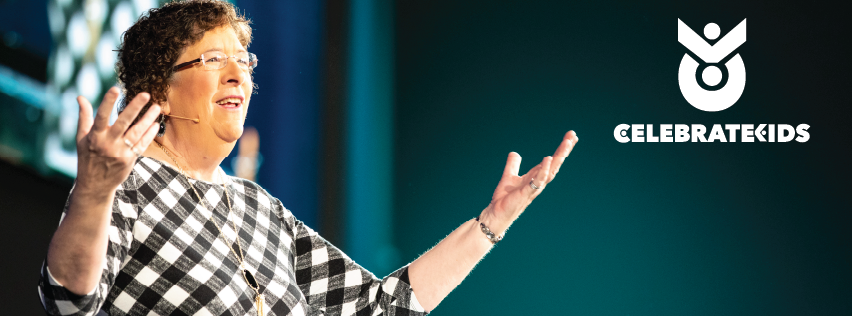
About Celebrate Kids
A child comes home with another disappointing grade.
Maybe math isn't clicking.
Maybe reading takes longer than it does for everyone else.
Maybe sitting still seems almost impossible.
Another child is thriving academically but struggling socially.
Another argues about everything.
One is creative but disorganized.
One remembers every song after hearing it once but can't remember the instructions you gave five minutes ago.
It is easy for adults to begin with the problem.
Why can't you concentrate?
Why aren't you motivated?
Why can't you be more like your brother?
Why do we keep having this argument?
Celebrate Kids encourages adults to begin somewhere else.
Who did God create this child to be?
That question changes the conversation.
Children Aren't Problems to Solve
Dr. Kathy Koch's own childhood helped shape this philosophy.
She describes herself as having been a tall, talkative child who didn't spell particularly well.
The adults around her could have reduced her to weaknesses.
Instead, her parents and other influential adults recognized strengths, patiently helped her develop weaker areas, encouraged resilience, and gave her confidence that she could learn.
Those experiences stayed with her.
Eventually, they became part of a much larger calling:
help adults truly know children.
Not the child they expected.
Not the child they wish they had.
The actual child standing in front of them.
Every Child Is Smart
One of Celebrate Kids' best-known frameworks begins with a deceptively simple statement:
Every child is smart.
The better question is:
How?
Through her 8 Great Smarts framework, Dr. Koch teaches that intelligence is broader than the narrow abilities traditionally emphasized in school.
Children can demonstrate strength through words, logic, pictures, music, physical movement, nature, relationships with people, and understanding themselves.
Celebrate Kids calls these:
Word Smart.
Logic Smart.
Picture Smart.
Music Smart.
Body Smart.
Nature Smart.
People Smart.
Self Smart.
The purpose isn't to put another label on a child.
It is to give adults a richer vocabulary for recognizing ability.
Stop Asking, “How Smart Are You?”
Imagine two children.
One reads years above grade level.
The other struggles with books but can take something apart, understand how its pieces fit together, and rebuild it.
If intelligence is measured only one way, the second child may gradually conclude:
I'm not smart.
That belief matters.
Children behave differently when they believe they are capable of learning.
Celebrate Kids therefore encourages parents and teachers to replace “How smart is this child?” with “How is this child smart?”
Now weaknesses can still be addressed without becoming the child's identity.
The child struggling with spelling may still need help with spelling.
But poor spelling doesn't get to define the whole person.
Smarts Aren't Trophies
Recognizing a child's strengths isn't supposed to produce entitlement.
Celebrate Kids connects ability with stewardship.
If God gave someone particular capacities, those abilities aren't merely there to make the child feel special.
They can be developed.
Used responsibly.
Put in service to other people.
Used for God's glory.
That changes affirmation.
Instead of simply telling children they are amazing, adults can help them understand what they have been given and what they can do with it.
Strength becomes responsibility.
Start With the Heart
Behavior presents another challenge.
A child complains.
Refuses to work.
Lies.
Quits.
Argues.
Adults naturally focus on stopping the behavior.
Celebrate Kids asks what is happening underneath it.
A behavior may grow from a belief.
A child who believes I can't do this behaves differently from one who believes this is difficult, but I can learn.
A child convinced that failure defines them may avoid trying.
A child who doesn't feel secure may seek control.
Changing the visible behavior without addressing the heart can therefore produce only temporary results.
That idea sits behind Dr. Koch's Start with the Heart approach.
Long-term change requires more than compliance.
Character Is Bigger Than Obedience
Celebrate Kids takes that idea further through its emphasis on character.
Parents understandably want obedient children.
But obedience alone doesn't necessarily produce maturity.
A child can comply because an adult is standing nearby.
Character determines what happens when nobody is watching.
Integrity.
Responsibility.
Self-control.
Perseverance.
Compassion.
Courage.
Humility.
Wisdom.
Celebrate Kids encourages adults to develop these qualities rather than becoming consumed with controlling individual behaviors.
The goal isn't simply a child who follows today's rule.
It is a young person increasingly capable of making wise, God-honoring decisions independently.
Five Needs Shape the Way We Live
Another major Celebrate Kids framework is Five to Thrive.
Dr. Koch identifies five core needs:
Security.
Identity.
Belonging.
Purpose.
Competence.
They build upon one another.
Security asks who can be trusted.
Identity asks who I am.
Belonging concerns who wants me.
Purpose addresses why I am alive.
Competence concerns what I can do well.
Those questions aren't limited to children.
Adults ask them too.
The difference is that children are still forming many of the answers.
Parents, teachers, peers, culture, technology, and ultimately their understanding of God can all influence what they come to believe.
Celebrate Kids wants adults to help children answer those needs in healthy, biblically grounded ways.
Identity Is Too Important to Leave to Culture
A child will develop an identity.
The question is what will shape it.
Grades can.
Appearance can.
Athletic ability can.
Popularity can.
Social media can.
Success can.
Failure can.
Other people's expectations can.
Celebrate Kids continually returns to another foundation:
God created this person intentionally.
That belief affects everything from intelligence to gender, purpose, character, and relationships.
Children aren't accidents attempting to invent meaning from nothing.
They are image-bearers who can discover how God has designed them and learn to steward that design faithfully.
Parents Need Encouragement Too
Celebrate Kids doesn't speak only about children.
It speaks to tired adults.
Parenting can produce an exhausting cycle of comparison.
Other people's children seem more obedient.
Someone else's teenager appears more responsible.
Another homeschool family seems more organized.
A friend's child earns better grades.
Parents can begin wondering what they did wrong.
Dr. Koch's work repeatedly pushes back against perfection.
Children don't need perfect parents.
Parents don't need perfect children.
They need relationships where people can learn, repent, forgive, mature, and grow.
Grace creates room for development.
Know Your Child Before Comparing Your Child
This becomes especially important when parents carry expectations into childhood.
Maybe Dad loved sports.
His son doesn't.
Mom was academically gifted.
Her daughter learns differently.
One child is outgoing.
Another needs solitude.
One processes ideas aloud.
Another needs time before speaking.
Celebrate Kids encourages parents to become students of their own children.
Observe.
Listen.
Ask questions.
Notice patterns.
Learn what energizes them.
Recognize where they struggle.
Understand how they think.
The more accurately a parent knows a child, the more intentionally that child can be guided.
Teachers Can Celebrate Kids Too
These principles naturally extend into education.
Dr. Koch holds a PhD in reading and cognition and brings educational research and classroom experience into Celebrate Kids' approach.
A classroom filled with children contains different ways of thinking, processing, remembering, creating, and communicating.
A teacher who recognizes those differences gains more ways to engage students.
Movement can become part of learning.
Music can reinforce memory.
Pictures can clarify concepts.
Discussion can engage relational learners.
Independent reflection can help others process.
Celebrate Kids doesn't treat educational differences as inconveniences to eliminate.
They can become pathways into learning.
Screens Are Forming Children Too
Modern parents also face an influence earlier generations never encountered at today's scale.
Screens.
Technology isn't treated as automatically evil.
But Celebrate Kids warns adults not to underestimate its formative power.
Devices compete for attention.
Algorithms influence interests.
Social media can shape identity.
Artificial intelligence changes how children think, create, research, and solve problems.
Digital environments can affect relationships and belonging.
Celebrate Kids therefore encourages adults to remain actively present.
Use technology intentionally.
Protect real relationships.
Preserve curiosity.
Give children opportunities to struggle through problems rather than outsourcing every difficulty to a device.
Help them experience the physical world.
Technology should remain a tool.
It shouldn't become the primary architect of a child's identity.
Equip the Adults Who Shape Children
This is where Celebrate Kids' ministry model becomes especially scalable.
Dr. Koch can't personally mentor every child.
She can equip the adults who influence them.
Parents.
Grandparents.
Teachers.
Pastors.
Youth workers.
Homeschool families.
School leaders.
Counselors.
Church leaders.
When one adult changes the way they understand children, that influence can multiply.
A teacher may affect hundreds of students over a career.
A pastor can influence families throughout a congregation.
A parent can reshape the emotional environment of a home.
Celebrate Kids therefore spends much of its energy teaching the adults around children how to see and guide them differently.
Books Become Tools
Dr. Koch's books have become a major part of that equipping work.
8 Great Smarts helps adults recognize and develop different forms of intelligence.
Five to Thrive explores security, identity, belonging, purpose, and competence.
Start with the Heart addresses motivation and lasting change.
Parent Differently focuses on developing character rather than merely modifying behavior.
No More Perfect Kids, coauthored with Jill Savage, challenges unrealistic expectations.
Other resources address technology, gender, adult children, learning, and family relationships.
Different topics.
The same underlying conviction keeps appearing:
Understand people accurately so you can influence them wisely.
Take the Teaching Beyond Books
Celebrate Kids also reaches families and leaders through conferences, schools, churches, conventions, podcasts, online courses, videos, articles, and daily digital encouragement.
Dr. Koch spends much of the year traveling to speak.
Her audiences include parents, educators, Christian school communities, homeschool families, pastors, ministry leaders, and young people themselves.
The organization also publishes frequent podcast teaching and practical resources designed to help adults apply its frameworks during ordinary family life.
The ministry isn't built around one annual event.
It tries to enter the everyday moments when adults actually need guidance.
Celebrate Doesn't Mean Indulge
The word celebrate can be misunderstood.
Celebrating a child doesn't mean approving every decision.
It doesn't mean removing discipline.
It doesn't mean telling children they are perfect.
And it doesn't mean pretending weaknesses don't exist.
Real celebration requires truth.
Know the child accurately.
Affirm what God has given them.
Correct what needs correction.
Strengthen weaknesses.
Develop character.
Set boundaries.
Expect growth.
And communicate throughout the process that failure doesn't erase the child's value.
Celebrate the person while helping the person mature.
Help Children See Themselves as God Sees Them
Ultimately, Celebrate Kids isn't simply an educational organization teaching learning styles.
Its worldview is explicitly Christian.
Children are created intentionally by God.
Their abilities are gifts to steward.
Character matters because they are called to follow Christ.
Identity shouldn't be built primarily from performance or culture.
Purpose reaches beyond personal achievement.
And adults have a responsibility to use their influence wisely.
That gives the word celebrate a deeper meaning.
To celebrate a child is to recognize God's workmanship without pretending the work is finished.
At the heart of Celebrate Kids is the conviction that children flourish when the adults around them learn to see them through the lens of God's intentional design. For roughly 35 years, founder Dr. Kathy Koch has helped parents, teachers, pastors, grandparents, and ministry leaders move beyond labels, comparison, perfectionism, and behavior management toward deeper questions of identity, character, motivation, intelligence, belonging, purpose, and discipleship. Through frameworks such as 8 Great Smarts, Five to Thrive, Start with the Heart, and Parent Differently, Celebrate Kids gives adults practical ways to understand the children entrusted to them. The goal isn't to produce perfect kids. It is to raise young people who know they are deeply loved, recognize how God has designed them, develop godly character, use their abilities responsibly, and grow into the people God created them to become.


