


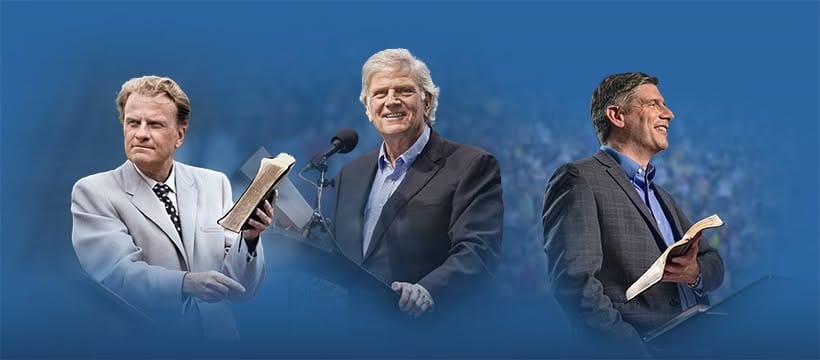
About the Billy Graham Evangelistic Association
In the summer of 1950, Billy Graham had $25,000 and nowhere to put it.
The money had been given for a new national radio ministry.
There was just one problem.
There wasn't an organization yet.
Billy Graham was already preaching evangelistic meetings around the country, and the 1949 Los Angeles Crusade had suddenly brought the young evangelist national attention. Invitations were multiplying. A radio opportunity had emerged. People wanted to support the work.
But the ministry infrastructure hadn't caught up with the mission.
Billy called his friend and business manager George Wilson.
Soon afterward, incorporation papers were filed in Minnesota.
On September 15, 1950, the Billy Graham Evangelistic Association was officially born.
The administrative problem had been solved.
Now the Gospel could travel.
Take the Message Wherever People Are
Billy Graham's ministry became known for enormous evangelistic Crusades.
Stadiums filled.
Choirs gathered.
George Beverly Shea sang.
Cliff Barrows led music.
Then Billy Graham stepped behind a pulpit and preached.
The sermons weren't built around obscure theological novelties.
Again and again, Graham returned to the same foundations.
Humanity is separated from God by sin.
Jesus Christ died for sinners.
Christ rose from the dead.
Forgiveness and eternal life are offered through Him.
People must personally respond to the Gospel.
At the end came the invitation.
People left their seats and walked forward.
But the Crusade wasn't supposed to end at the stadium exit.
Local churches were deeply involved in preparation, volunteers were trained, and those responding to the Gospel could be connected with Christians who would help them take their next steps.
Evangelism and the local church were meant to work together.
Then Put the Same Gospel on the Radio
Billy Graham understood something early that would shape the organization for decades:
People don't always have to come to the evangelist.
Technology can carry the evangelist to them.
In November 1950, The Hour of Decision went on the air.
Radio signals carried preaching far beyond the physical audience sitting in front of Billy Graham.
Television followed.
Films followed.
Newspaper columns followed.
Decision magazine followed.
Eventually there were satellite broadcasts, websites, online videos, social media, podcasts, livestreams, and digital evangelism.
Each new medium presented the same question.
Can this help someone hear about Jesus?
If the answer was yes, BGEA was willing to explore it.
The Stadium Was Never Really the Point
Billy Graham eventually preached to enormous audiences.
But the size of the crowd wasn't supposed to become the message.
One person responding to Christ mattered.
That principle helps explain why BGEA's evangelistic work can operate at radically different scales today.
Franklin Graham can preach to thousands at a Festival or evangelistic outreach.
Will Graham can proclaim the Gospel through a Celebration.
Someone else may encounter a Gospel presentation alone on a phone.
Another person calls the prayer line at two in the morning.
Different setting.
Same person-to-person concern.
BGEA wants the Gospel to reach people wherever they actually are.
Let the Internet Become an Evangelistic Field
The digital world created an opportunity Billy Graham's earliest team could never have imagined.
People now type spiritual questions into search engines privately.
They search for hope after a relationship ends.
They wonder whether God could forgive them.
They ask who Jesus is.
They look for prayer when they don't know whom else to call.
BGEA's internet evangelism ministry meets people in that environment.
Through Search for Jesus and other digital resources, people can encounter Gospel presentations and connect with trained volunteers online.
That creates an interesting continuation of the old Crusade model.
The stadium may be gone.
The conversation after the message remains.
Someone hears the Gospel.
Someone responds.
Another Christian helps them understand what comes next.
Show Up When Life Suddenly Falls Apart
Evangelism also happens in places no one would choose to visit.
A tornado destroys a neighborhood.
A shooting leaves a community grieving.
A hurricane forces families from their homes.
Wildfires consume everything someone spent decades building.
Those are the places served by the Billy Graham Rapid Response Team.
Crisis-trained chaplains deploy following natural and human-caused disasters to provide emotional and spiritual care.
They listen.
They pray.
They sit with people in grief.
They help someone process a day that may have changed the rest of their life.
The setting is very different from a Crusade platform.
The ministry is quieter.
Sometimes the most meaningful thing a chaplain can do is simply remain beside someone while they tell their story.
Christian hope enters through presence before it becomes a conversation.
Equip Christians to Share Their Faith Too
Billy Graham couldn't personally speak with everyone who needed to hear the Gospel.
Neither can Franklin Graham.
Neither can any evangelist.
So multiplication matters.
BGEA provides resources designed to help ordinary Christians become more confident about sharing Christ with family members, coworkers, neighbors, and friends.
The Billy Graham Training Center at The Cove provides another setting for spiritual growth and ministry training.
Pastors and Christian leaders can step away from the demands of everyday ministry, study Scripture, receive encouragement, and return better prepared to serve.
The organization also trains crisis chaplains and equips Christians for specific forms of evangelistic ministry.
The objective isn't simply to produce more people who listen to evangelists.
It's to equip more Christians to evangelize.
Let a Life of Evangelism Keep Preaching
Billy Graham died in 2018 at the age of 99.
But visitors can still walk through the story of his ministry.
The Billy Graham Library in Charlotte, North Carolina, isn't designed simply as a museum honoring a famous preacher.
Its exhibits tell the story of how a North Carolina farm boy became an evangelist who preached across the world.
Visitors encounter photographs, films, personal artifacts, historic Crusades, and the people who worked alongside him.
They can also visit Billy and Ruth Graham's graves and see Billy's restored childhood home.
Yet the story continually points beyond Billy Graham.
That was intentional.
The Library is another evangelistic ministry.
The life being remembered becomes another opportunity to explain the Gospel that life was spent proclaiming.
One Message, Every Effective Means
Look across BGEA's history and the methods can almost tell the history of modern communication.
Tent meetings.
Stadiums.
Radio.
Television.
Film.
Newspapers.
Magazines.
Telephone ministry.
Satellite broadcasts.
Websites.
Streaming video.
Social media.
Online evangelism.
The technology keeps moving.
BGEA keeps moving with it.
Yet the organization hasn't spent more than seven decades searching for a new central message.
It keeps returning to the old one.
Human beings need reconciliation with God.
Jesus Christ died and rose again.
Forgiveness is available.
The Gospel should be proclaimed.
And every generation of Christians has to decide how to carry that message into the places people are actually listening.
At the heart of the Billy Graham Evangelistic Association is a mission Billy Graham spent his life pursuing: proclaim Jesus Christ to as many people as possible and equip the church to do the same. From packed stadiums and the historic broadcasts of The Hour of Decision to Franklin and Will Graham's evangelistic outreaches, digital evangelism, crisis chaplains, prayer ministry, training, publishing, and the Billy Graham Library, the methods continue to evolve while the center remains unchanged—the Gospel of Jesus Christ, carried to the world by every effective means available.


