


About Bridges To Life
John Sage knew what crime looked like from the victim's side.
In 1993, his sister Marilyn was murdered.
The men responsible were caught.
They were convicted.
They received severe sentences.
Justice had moved through the legal system.
But John's grief didn't disappear when the courtroom emptied.
For years, he wrestled with anger, trauma, and the enormous hole his sister's death had left behind.
Then, in 1998, he walked into a prison.
Not as an inmate.
Not as an attorney.
Not as a correctional officer.
As a crime victim.
What happened there eventually became Bridges To Life.
When Punishment Doesn't Tell the Whole Story
Prison makes the consequences of crime obvious in one sense.
A person loses freedom.
But understanding the sentence isn't necessarily the same as understanding the damage.
Crime spreads.
A murder leaves parents without a child.
A robbery can leave someone afraid inside their own home.
Violence affects spouses, children, friends, coworkers, and entire communities.
Even the offender's own family may suffer consequences for something they didn't do.
John encountered a prison program where victims shared those experiences directly with incarcerated people.
He watched something happen.
People began listening.
Offenders who had thought primarily about what their crimes had cost themselves started confronting what their actions had done to someone else.
At the same time, telling the story could become meaningful for the victim.
John experienced some of that healing himself.
He wanted others to experience it too.
Bridges To Life was founded later that year.
Put a Human Face on the Harm
The BTL program revolves around restorative justice.
Traditional criminal justice naturally asks important questions about laws, guilt, punishment, and public safety.
Restorative justice introduces another question:
What has been broken, and what would it mean to take responsibility for that harm?
For fourteen weeks, incarcerated participants meet in small groups with trained volunteers.
They work through BTL's Restoring Peace curriculum.
They read.
Journal.
Talk.
Tell their own stories.
And gradually work through subjects connected with responsibility, confession, repentance, forgiveness, and restitution.
Then crime victims enter the conversation.
They tell their stories.
These aren't necessarily the victims of the particular offenders sitting in front of them.
That separation matters.
The purpose isn't confrontation between one offender and their victim.
It's helping participants encounter the reality of victimization through another human being.
Statistics become faces.
Consequences become stories.
Empathy Can Become the Beginning of Responsibility
Someone can admit committing a crime without fully understanding its impact.
BTL tries to close that distance.
Hearing a victim describe what happened afterward can expose consequences an offender never considered.
The sleepless nights.
Fear.
Family tension.
Financial damage.
Grief.
Children growing up without someone.
A sense of safety that never completely returned.
This is why victim impact occupies such an important place in the program.
BTL believes empathy can become a doorway to accountability.
Once someone recognizes the suffering their choices can create, responsibility becomes harder to reduce to simply serving time.
The question changes from:
"What happened to me because I committed this crime?"
to something deeper:
"What happened to other people because of what I did?"
That's uncomfortable territory.
BTL deliberately goes there.
Let the Offender Tell Their Story Too
Restorative justice isn't only about hearing victims.
Participants eventually have to examine their own lives.
The curriculum creates room for them to tell their stories inside the small group.
That doesn't excuse criminal behavior.
Understanding how someone arrived at destructive choices is different from denying responsibility for those choices.
A life may contain addiction.
Abuse.
Anger.
Abandonment.
Poor decisions.
Broken relationships.
Violence.
Shame.
Eventually, those pieces need to be brought into the open.
BTL asks participants to look backward honestly so they can begin thinking differently about the future.
Responsibility means acknowledging what happened without hiding behind what happened to you.
Forgiveness Doesn't Mean Pretending Nothing Happened
Because Bridges To Life is faith-based, forgiveness runs deeply through its work.
But forgiveness isn't presented as pretending crime wasn't serious.
The entire program depends upon taking harm seriously.
BTL's spiritual mission is to show victims and offenders the transforming power of God's love and forgiveness.
That makes forgiveness part of restoration rather than denial.
For the offender, it can mean confronting guilt without believing the worst thing they have ever done must define everything they will ever become.
For a victim, forgiveness may become part of a long process of loosening the grip that another person's crime has had on their life.
The journeys are different.
Both can require grace.
Volunteers Cross the Prison Wall
Bridges To Life is heavily volunteer-driven.
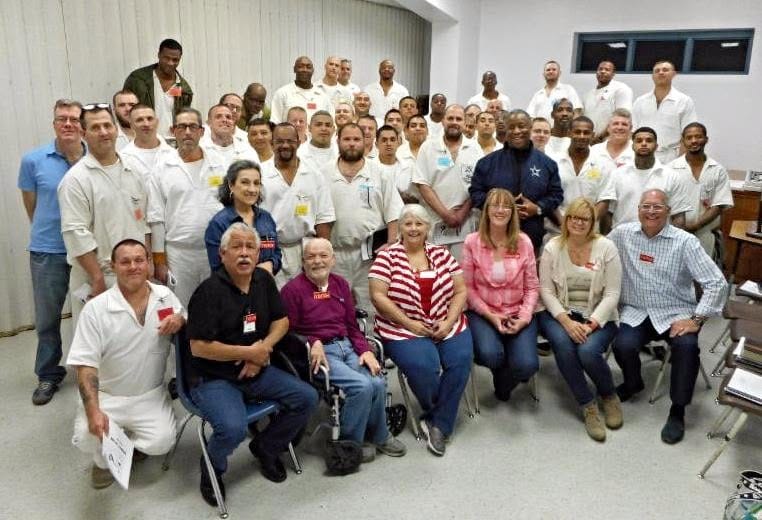
Ordinary people enter correctional facilities each week and sit in circles with incarcerated men and women.
They aren't required to be therapists.
They don't need professional counseling credentials.
Some serve as facilitators, guiding discussions and listening as participants work through the curriculum.
Crime victims can serve as speakers, entering the facility at specific points to tell their stories.
A volunteer's role isn't to arrive as the person who has everything figured out.
Listening matters.
Consistency matters.
Showing up week after week matters.
Over fourteen weeks, relationships begin forming across a boundary that usually keeps the community and prison population completely separated.
That connection is part of the organization's name.
Bridges.
Faith-Based Doesn't Mean Faith Is Required
There's an important distinction in how BTL operates.
It is openly faith-based.
Bible stories and verses appear in its curriculum.
God's love and forgiveness are explicitly part of its spiritual mission.
Yet participation isn't restricted to Christians.
People of other religions can participate.
People with no religious faith can participate.
BTL says it does not require participants to adopt a particular faith and does not use the program to proselytize.
That allows its restorative justice framework to operate inside diverse correctional environments while retaining the spiritual convictions that helped inspire it.
The Goal Eventually Reaches Outside the Prison
The fourteen-week program happens inside.
Its consequences are supposed to travel outside.
Eventually, many participants return home.
They become neighbors again.
Parents.
Spouses.
Employees.
Members of communities.
If someone returns with greater empathy, personal responsibility, healthier ways of handling conflict, and a different understanding of their past choices, the benefits extend beyond that individual.
Fewer new crimes mean fewer new victims.
That is why reducing recidivism is central to BTL's mission.
Public safety and personal transformation aren't competing goals.
One can help produce the other.
Build a Bridge in Both Directions
Bridges To Life could have become a ministry focused only on prisoners.
Its origin prevented that.
The organization began because a crime victim needed healing.
That keeps victims inside the story.
The offender needs to understand the harm.
The victim deserves to have that harm acknowledged.
The community needs people returning from incarceration prepared to live differently.
And BTL believes God's love and forgiveness can enter all of those places.
A prison wall separates people physically.
Restorative justice asks whether understanding, accountability, forgiveness, and hope can cross it anyway.
At the heart of Bridges To Life is the belief that the damage caused by crime does not have to be the final chapter for either the victim or the offender. By bringing community volunteers and crime victims into correctional facilities, BTL helps incarcerated men and women confront the ripple effects of their choices, develop empathy, accept responsibility, and begin pursuing a different future. At the same time, victims are given a place for their stories to be heard and their own healing to continue. The bridge runs both ways—toward accountability on one side, healing on the other, and the possibility of restoration through the transforming power of God's love and forgiveness.


