


About Caritas Canada
A family can receive food after a disaster.
That's good.
But eventually another question has to be asked.
Why were they so vulnerable before the disaster happened?
Perhaps they didn't own the land they farmed.
Maybe conflict had already displaced them.
A mining operation contaminated the water their community depended upon.
Women were excluded from decisions.
Farmers couldn't control the resources needed to support their families.
Or political systems simply allowed some communities to remain invisible.
Development and Peace — Caritas Canada believes Christian compassion has to be willing to ask that second question.
Help the person suffering now.
Then look at what keeps producing the suffering.
Development Is the New Name for Peace
The organization was born during a remarkable period in the Catholic Church.
The Second Vatican Council had recently concluded.
Bishops from Africa, Asia, Latin America, and elsewhere were forcing the global Church to look more seriously at poverty, hunger, inequality, and the realities facing people outside wealthy nations.
Then, in 1967, Pope Paul VI issued Populorum Progressio.
Its message challenged simplistic ideas about development.
A richer economy alone doesn't create human flourishing.
Real development has to involve the whole person.
And peace cannot simply mean that nobody is currently shooting.
Peace requires justice.
Canada's Catholic bishops responded that same year by establishing the Canadian Catholic Organization for Development and Peace.
The name carried the idea:
Development and peace belong together.
Don't Arrive With Someone Else's Solution
Development and Peace doesn't primarily operate by sending Canadians abroad to manage poor communities.
Its model centers on partnership.
Local organizations understand their communities.
They know the political realities.
The history.
The land.
The language.
The injustices.
The people who have been overlooked.
So Development and Peace works through local partners and social movements across Africa, Asia, Eastern Europe, Latin America, and the Middle East.
Those organizations don't simply implement a Canadian plan.
They help shape the work.
Development and Peace describes people as the architects of their own development.
That changes the relationship from charity alone to solidarity.
Stand Beside People Defending Their Own Dignity
Sometimes development means helping a community secure food.
Elsewhere it means helping Indigenous people defend ancestral land.
A women's organization may be confronting violence.
Farmers may be resisting land grabbing.
A community may be protecting water from pollution.
Civil society organizations may be trying to participate in decisions that affect millions of people.
Peacebuilders may be bringing divided groups back into dialogue.
Development and Peace supports those kinds of movements because it believes poverty often has causes larger than an individual's choices.
If an unjust structure repeatedly pushes people toward poverty, changing the structure becomes part of development.
Put Women at the Heart of Change
Women frequently experience poverty, displacement, conflict, and environmental pressures differently.
But Development and Peace doesn't view women merely as a vulnerable group requiring protection.
It describes them as agents of change.
Women organize communities.
Defend human rights.
Produce food.
Lead peacebuilding.
Support families.
Build local economies.
And challenge systems that exclude them.
The organization therefore prioritizes women's participation and leadership within its programs.
Supporting a woman isn't only about improving her individual circumstances.
When women gain meaningful influence over decisions, the effects can spread through families and entire communities.
Respond When There Isn't Time to Wait
Long-term systemic change matters.
But someone fleeing war cannot wait for a five-year development strategy.
Humanitarian emergencies require immediate action.
Development and Peace responds to conflicts, natural disasters, displacement, hunger, and other crises through local partners and the wider Caritas network.
The response depends on the emergency.
A family may need food.
Another needs cash assistance.
Someone needs medical treatment.
A displaced woman needs a safe shelter.
Children need protection.
Communities need clean water.
The organization can move between immediate humanitarian relief and longer-term recovery because its partnerships often remain after the emergency disappears from international headlines.
Let Creation Care Become Human Care
Environmental justice has also become increasingly important.
For communities depending directly on land, forests, rivers, and rainfall, environmental destruction can quickly become human suffering.
A polluted river affects drinking water.
Deforestation affects livelihoods.
Mining can displace communities.
Climate pressures can undermine agriculture.
Development and Peace therefore treats ecological and social concerns as interconnected.
This reflects Pope Francis's idea of integral ecology.
The cry of the earth and the cry of the poor cannot always be separated.
Protecting creation can become part of protecting the people whose lives depend most directly upon it.
Bring the Mission Back to Canada
Half of the organization's identity exists outside Canada.
The other half exists inside it.
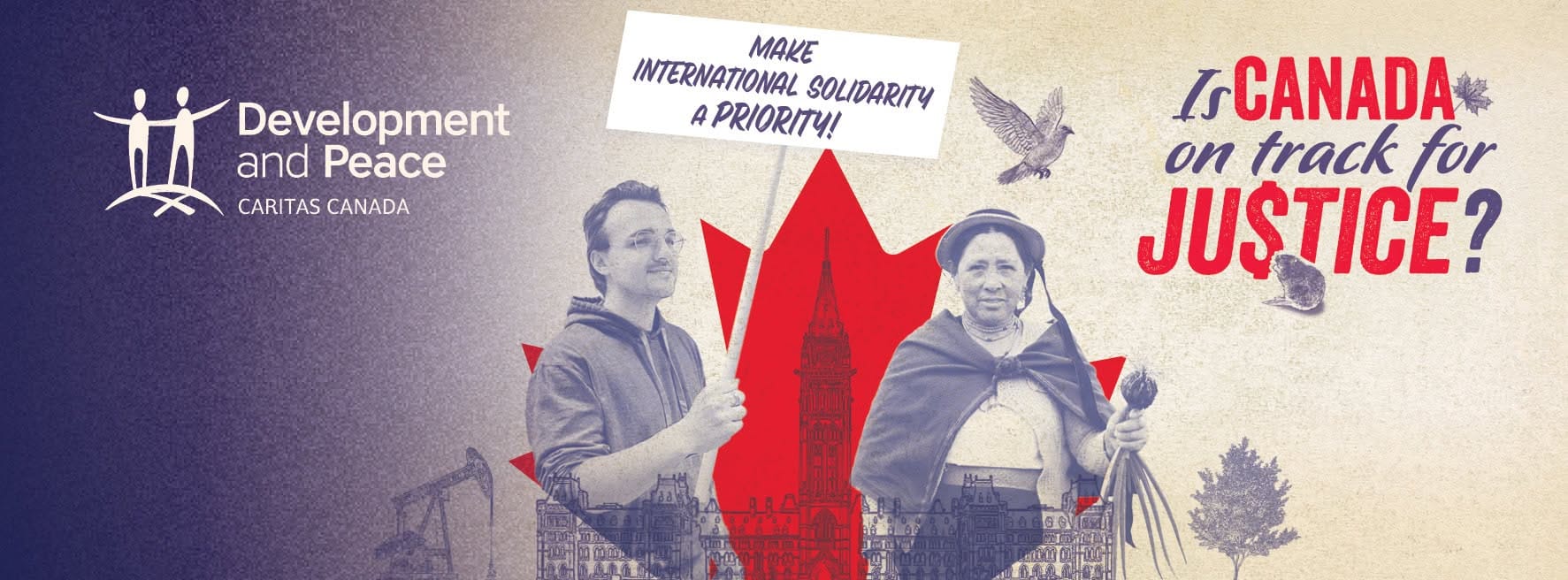
Development and Peace describes itself as having a two-fold mission.
Internationally, it supports community development and humanitarian aid.
Within Canada, it educates and mobilizes people.
That second half is important.
Canadian Catholics are encouraged not simply to donate but to understand.
Why does poverty persist?
How do Canadian policies affect communities elsewhere?
What responsibilities do corporations have when operating internationally?
What happens when consumer choices are connected with environmental damage or labor exploitation somewhere else?
Solidarity requires learning how your own life may be connected to another person's struggle.
Turn Lent Into Solidarity
That connection becomes especially visible through Share Lent.
The first Share Lent campaign took place in 1968.
Catholics across Canada were invited to connect the spiritual disciplines of Lent with people experiencing poverty and injustice around the world.
Prayer becomes connected to action.
Fasting creates room for generosity.
Almsgiving becomes solidarity.
Parishes remain essential to that work.
Development and Peace parish representatives bring campaigns into local Catholic communities, organize activities, raise funds, educate parishioners, and encourage advocacy.
The international mission enters the local parish.
A Member Can Become Part of the Movement
Development and Peace doesn't describe itself only as a charity.
It calls itself a democratic movement for international solidarity.
That language matters.
Thousands of members across Canada participate in local groups, diocesan councils, campaigns, education, advocacy, fundraising, and governance.
The person supporting Development and Peace isn't meant to remain merely a donor receiving an annual receipt.
They can become an advocate.
A parish representative.
An educator.
A campaigner.
Someone helping other Canadians understand the connections between faith and global justice.
Catholic Social Teaching Provides the Framework
The organization doesn't hide where its philosophy comes from.
Human dignity begins with the belief that every person is created in the image and likeness of God.
The common good asks Christians to think beyond individual success.
Solidarity refuses to treat suffering on the other side of the world as somebody else's problem.
Subsidiarity respects the ability of local communities to make decisions.
Preferential concern for people experiencing poverty directs attention toward those most easily ignored.
Care for creation recognizes that human flourishing and the health of the planet are connected.
Together, these principles shape what Catholic tradition calls Integral Human Development.
Development is not simply increasing someone's income.
It is helping create conditions in which the whole person and community can flourish.
Charity Responds. Solidarity Stays.
There is a difference between seeing someone as a recipient and seeing them as a partner.
A recipient receives what you have.
A partner brings something to the relationship too.
Knowledge.
Experience.
Leadership.
Courage.
Culture.
Ideas.
Development and Peace has spent decades moving toward that second model.
A community in the Global South isn't waiting for Canada to become its hero.
People are already organizing.
Already resisting injustice.
Already rebuilding.
Already defending land.
Already creating peace.
Already imagining a different future.
Development and Peace asks how Canadian Catholics can stand beside them.
That is solidarity.
At the heart of Development and Peace — Caritas Canada is a Catholic conviction that peace cannot be separated from justice and human dignity. Since 1967, the organization has responded to humanitarian emergencies while also working alongside local organizations and social movements confronting the deeper causes of poverty, oppression, inequality, conflict, and environmental destruction. Its role isn't to arrive as the outsider with every answer. It is to listen, partner, provide resources, amplify voices, and mobilize Canadians to recognize their own responsibilities within a connected world. Food during a crisis matters. So does changing the conditions that keep producing hunger. Emergency shelter matters. So does building a society where people can live securely. Development and Peace tries to hold those responsibilities together—charity when someone needs help now, and solidarity that remains long enough to pursue justice.


