


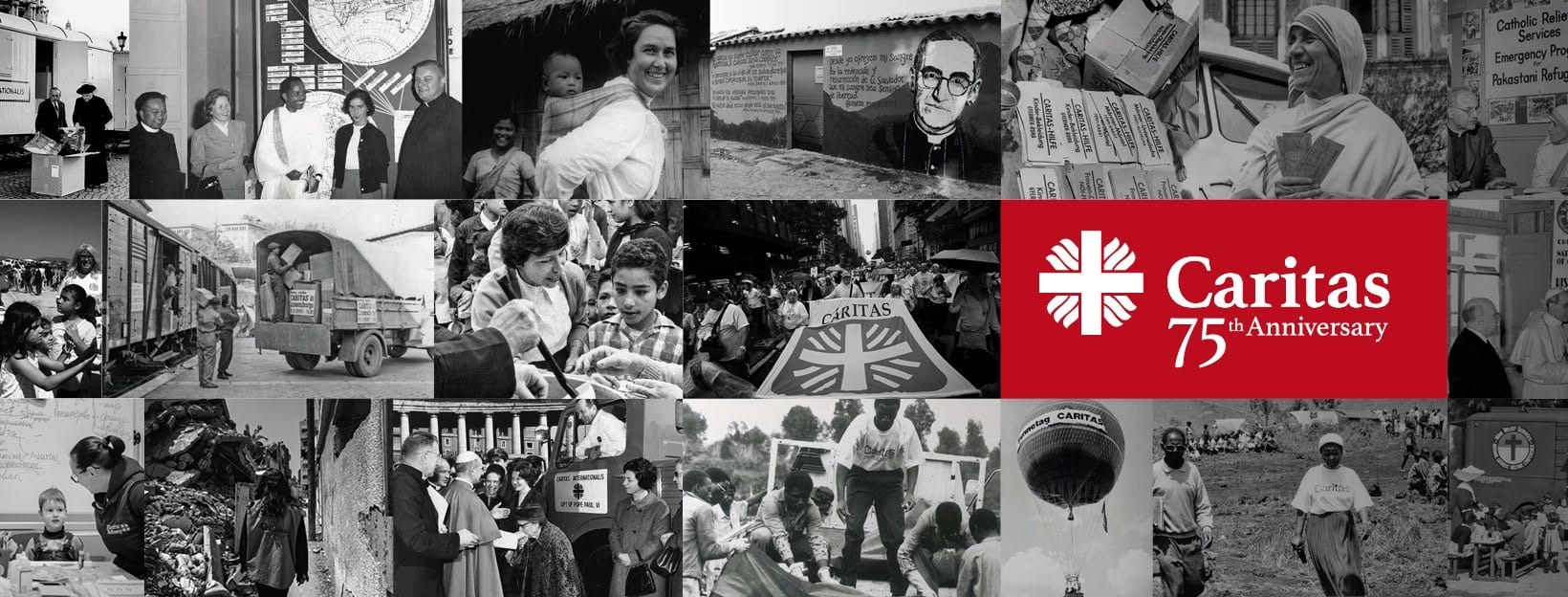
About Caritas Internationalis
A cyclone hits an island.
War forces families across a border.
Drought destroys a harvest.
A refugee arrives somewhere unfamiliar.
An elderly person becomes isolated.
A community struggles with poverty that has lasted for generations.
Somewhere nearby, there may already be a Caritas.
Not someone arriving from Rome.
Not necessarily an international aid worker.
Someone local.
A parish volunteer.
A diocesan team.
A national Catholic organization.
People who already know the language, the community, the roads, the culture, and often the families themselves.
That local presence is the foundation of Caritas Internationalis.
Its strength comes from connecting those thousands of expressions of Catholic charity into one worldwide family.
One Caritas, Many Organizations
Caritas Internationalis can be difficult to understand because it isn't one enormous charity operating identical programs everywhere.
It is a confederation.
Its members are national Caritas organizations rooted within their respective Catholic churches.
Those organizations remain autonomous.
They understand their own countries.
They establish programs appropriate to local needs.
They work through dioceses, parishes, community organizations, volunteers, and professional staff.
Caritas Internationalis brings them into communion.
That means a Catholic organization responding to poverty in Africa can belong to the same family as one resettling refugees in Europe, responding to cyclones in the Pacific, supporting farmers in Latin America, or advocating for vulnerable families in North America.
Different ministries.
One network.
Keep Decisions Close to the People
There is a Catholic principle underneath this structure:
subsidiarity.
Put simply, decisions should be made as close as reasonably possible to the people affected by them.
If a local organization understands its community, an international headquarters shouldn't automatically take control.
If a national Caritas has the capacity to respond, strengthen that capacity.
If communities can participate in determining their own future, don't reduce them to recipients waiting for someone else to decide what is best.
Caritas Internationalis formally describes strengthening national, diocesan, and parish Caritas organizations as central to how the confederation works.
The global network exists partly to make local action stronger.
When Disaster Strikes, the Network Wakes Up
That structure becomes especially powerful during emergencies.
Imagine a major earthquake.
The local Caritas may already have people near the affected communities.
Its national organization understands the country's institutions and humanitarian environment.
Regional Caritas organizations can help coordinate.
Members elsewhere can mobilize funding.
The international confederation can connect the response.
The world suddenly sees an emergency.
Caritas may have been there long before it happened.
Depending on the crisis, the response can involve food, shelter, water, sanitation, healthcare, protection, cash assistance, psychosocial support, or other urgent needs.
But the network doesn't have to build every relationship from scratch after the disaster.
Many of those relationships already exist.
Stay When the Cameras Leave
Emergency relief is only one part of Caritas.
Eventually the television crews leave.
Families still need homes.
Farmers need livelihoods.
Children need education.
Communities need functioning water systems.
People traumatized by conflict still need support.
Caritas organizations therefore work across the longer journey from relief to recovery and development.
The exact programs differ around the world.
That flexibility matters.
Poverty in rural Africa may require a different response from social exclusion in a European city.
Migration in Latin America differs from displacement caused by conflict in the Middle East.
The Caritas model allows the response to remain local while connecting it with international solidarity.
Human Dignity Comes Before the Program
Catholic Social Teaching gives the network its deeper framework.
Caritas begins with the dignity of the human person.
Someone experiencing poverty isn't a lesser person.
A refugee isn't merely a humanitarian case.
A hungry child isn't an image for a fundraising campaign.
Each possesses intrinsic worth.
That affects how assistance should be given.
Caritas says it wants people experiencing poverty to be active participants in building their futures rather than objects of pity.
The difference can seem subtle.
In practice, it changes everything.
Charity becomes something done with people rather than merely for them.
Serve the Person in Front of You
Caritas is unmistakably Catholic.
It describes its work as an expression of the social mission of the Catholic Church.
Its values come from Christian teaching.
Its structures are connected to bishops, episcopal conferences, dioceses, parishes, and the Holy See.
But assistance isn't reserved for Catholics.
Caritas commits itself to serving people in need regardless of ethnicity, sex, age, religion, or belief.
The person doesn't need to become Catholic before receiving food.
A Muslim family fleeing war remains worthy of protection.
A person with no religion still possesses dignity.
A disaster doesn't ask someone's denomination before destroying a home.
The Christian identity explains why Caritas serves.
Human need helps determine whom it serves.
Charity Must Sometimes Confront Injustice
Giving food to someone who is hungry is an act of charity.
But suppose the same community remains hungry because its people are repeatedly excluded from resources that should be available to them.
Now another question appears.
Why?
Caritas Internationalis doesn't treat charity and justice as enemies.
Its Catholic social vision includes both.
Feed people experiencing hunger.
Then listen to them.
Understand what is keeping them poor.
Defend human rights.
Challenge structures that undermine human dignity.
Advocate for policies that protect vulnerable communities.
Stand beside people whose voices are being ignored.
Caritas describes this as taking the cause of people experiencing poverty as its own.
Hear the Cry of the Poor and the Cry of the Earth
Environmental concerns increasingly belong within that same framework.
The poorest communities are often highly dependent on the natural environment.
Rainfall determines whether crops survive.
Healthy soil determines whether families eat.
Waterways provide drinking water.
Forests sustain livelihoods.
When ecosystems deteriorate, people living closest to poverty may have the fewest resources available to adapt.
Caritas therefore connects social justice with care for creation.
The Catholic concept of integral ecology recognizes that environmental problems and human problems frequently belong to the same story.
Protecting creation can become an act of protecting your neighbor.
Solidarity Means Your Suffering Concerns Me
Another Catholic principle gives the global confederation its character:
solidarity.
Solidarity goes further than sympathy.
Sympathy says, “I feel sorry that this happened to you.”
Solidarity says, “What happens to you concerns me because we belong to one human family.”
That idea becomes remarkably tangible within Caritas.
A parish in one country can help finance an emergency response thousands of miles away.
One national organization can share expertise with another.
Caritas members can collectively advocate before international institutions.
Resources can cross borders.
Knowledge can cross borders.
And compassion can cross borders.
The suffering may be local.
The response becomes global.
A Catholic Network Born From a World in Ruins
The modern confederation grew from catastrophe.
Catholic charitable organizations already existed before the Second World War, including the first Caritas organization established in Germany in 1897.
But two world wars demonstrated how urgently Catholic relief organizations needed greater international cooperation.
Europe emerged from World War II devastated.
Millions were displaced.
Cities had been destroyed.
Families were separated.
Poverty and hunger were widespread.
Catholic relief organizations were responding, but coordination could make their efforts stronger.
In 1951, representatives gathered in Rome for the constitutional assembly of what became the international Caritas confederation.
Thirteen original members formed the new organization.
A few years later, it officially adopted the name Caritas Internationalis.
The world that produced Caritas Internationalis has changed dramatically.
The reason for cooperation hasn't.
Autonomy in Communion
Perhaps the best way to understand Caritas Internationalis is through an idea that helped inspire its structure:
autonomy in communion.
Each national Caritas remains rooted in its own church and country.
Yet none needs to stand completely alone.
They belong to something larger.
When one member confronts catastrophe, others can respond.
When one develops expertise, others can learn.
When vulnerable communities need their concerns heard internationally, the confederation can amplify them.
Local identity isn't erased by global unity.
It becomes stronger through it.
That is what turns hundreds of Catholic organizations into the Caritas family.
Love Becomes Organized
“Caritas” means love or charity.
On the smallest scale, that might look like one Christian sharing food with someone who is hungry.
Scale that instinct outward.
A parish organizes.
Then a diocese.
Then a national church.
National organizations cooperate regionally.
Regional networks connect globally.
Eventually, an act as personal as loving your neighbor becomes a worldwide humanitarian system.
The structures become complicated.
The principle doesn't have to.
Someone is suffering.
Move toward them.
Protect their dignity.
Listen before deciding what they need.
Stand beside them.
Challenge injustice when necessary.
Care for the world they depend upon.
And remember that the person receiving assistance belongs to the same human family as the person giving it.
At the heart of Caritas Internationalis is the Catholic conviction that love of neighbor can cross every border without losing its local character. Born from the devastation surrounding the world wars, the confederation connects autonomous Catholic organizations so that a parish, diocese, national Caritas, regional network, and worldwide Church can act in solidarity when people face poverty, disaster, displacement, hunger, exclusion, or injustice. Yet its model deliberately tries to keep people closest to the problem closest to the decisions. Human dignity comes first. Local communities matter. Charity and justice belong together. And when one part of the human family suffers, Caritas believes the rest of the family should not simply watch from a distance.


