


About Caritas Europa
A person experiencing homelessness in Spain.
A Ukrainian family displaced by war.
An elderly person who can no longer afford adequate care.
A refugee trying to build a new life in Belgium.
A family pushed toward poverty by rising living costs.
They may never meet one another.
They may not even speak the same language.
But somewhere nearby, there may be a Caritas.
That is what makes Caritas Europa unusual.
It isn't simply one organization trying to serve an entire continent.
It is a network connecting Catholic organizations already rooted within their own countries and communities.
49 members.
46 European countries.
Different languages.
Different social systems.
Different challenges.
One Catholic commitment to place the human person at the center.
Let Help Begin Close to Home
Europe is too diverse for every problem to be solved from Brussels.
Caritas Europa understands that.
Its national members possess their own histories, structures, staff, volunteers, diocesan relationships, parishes, programs, and areas of expertise.
Some operate shelters.
Some work with refugees.
Some provide food assistance.
Others offer employment services, counseling, long-term care, emergency response, housing support, or international development programs.
The precise work changes from country to country because the needs change too.
Caritas Europa doesn't replace that local knowledge.
It connects it.
A national Caritas can remain deeply rooted in its own community while drawing upon the experience and solidarity of a much larger European and global family.
See the Person Before the Problem
Catholic Social Teaching provides the foundation underneath that network.
For Caritas, poverty isn't merely a statistical category.
Migration isn't merely a political issue.
An elderly person isn't a demographic challenge.
A homeless person isn't a housing unit waiting to be filled.
Each is a human being with inherent dignity.
That belief shapes how Caritas Europa approaches social policy and humanitarian work.
Human dignity comes first.
Then come principles such as solidarity, participation, the preferential option for people experiencing poverty, the dignity of work, rights and responsibilities, family and community, and care for our common home.
The person cannot disappear behind the program designed to help them.
Listen to Poverty From the Ground Up
This local presence gives Caritas Europa something especially valuable:
proximity.
A policymaker may see unemployment percentages.
A Caritas worker meets the person who lost the job.
A government report may measure housing costs.
A local Caritas sees the family choosing between rent and food.
Migration appears in political debates as numbers crossing borders.
Caritas encounters the individual trying to learn a language, find housing, secure employment, and rebuild a life.
Caritas Europa gathers those experiences and brings them into a wider European conversation.
Its advocacy is therefore connected with what member organizations witness every day.
Charity Can Ask Political Questions
That means Caritas Europa doesn't stop at providing services.
It also advocates.
Why are people working and still unable to escape poverty?
Are social-protection systems actually protecting people?
Can families access affordable housing?
Are migrants and asylum seekers being treated with dignity?
Can elderly people receive adequate long-term care?
Are economic systems increasing inequality?
Those questions inevitably enter public policy.
Caritas Europa engages European institutions and policymakers because it believes Christian concern for people experiencing poverty also requires attention to the structures affecting their lives.
A food parcel can help tonight.
A fairer social system may help prevent someone from needing the parcel next year.
Both matter.
Welcome the Stranger as a Person
Migration is one of the clearest places where Caritas Europa's local service and European advocacy meet.
Across the network, Caritas organizations encounter refugees, asylum seekers, migrants, and displaced families directly.
They help people navigate new countries.
Find shelter.
Learn languages.
Access services.
Enter employment.
Build relationships.
And begin again.
That experience shapes Caritas Europa's public advocacy.
The organization argues that migration policy must keep human dignity and protection at its center.
Borders are real.
Policies are necessary.
But neither eliminates the humanity of the person standing at the border.
When War Comes to Europe
The war in Ukraine has made the strength of a network especially visible.
When millions of people suddenly needed assistance, Caritas did not have to invent a humanitarian presence across Europe from nothing.
Organizations were already there.
Caritas organizations inside Ukraine responded.
Neighboring countries received refugees.
Other European members provided resources and solidarity.
The broader confederation helped coordinate support.
A local network became a humanitarian network almost overnight.
That is one of the practical advantages of Caritas.
The relationships needed during a crisis often existed before the crisis began.
Prepare Before the Next Emergency
Responding well after disaster strikes is important.
Being ready beforehand is better.
Caritas Europa therefore works to strengthen emergency preparedness among its member organizations.
Training, humanitarian standards, safeguarding, coordination, organizational development, and knowledge sharing all matter before an emergency reaches the headlines.
One Caritas organization can learn from another.
Experience gained responding to floods in one country may help a member preparing for another disaster elsewhere.
Lessons from the Ukrainian response can strengthen future humanitarian work.
The network becomes a place where knowledge travels.
Poverty Exists in Europe Too
International humanitarian organizations are often associated with poverty somewhere far away.
Caritas Europa refuses that geographical assumption.
Poverty is also European.
People struggle with housing.
Energy costs.
Food insecurity.
Social isolation.
Unemployment.
Inadequate wages.
Disability.
Child poverty.
Exclusion.
Ageing.
Long-term care.
Caritas Europa studies those realities through initiatives such as its Caritas CARES! research.
The research combines evidence with the experience of Caritas organizations working directly with people affected by European social systems.
That allows Caritas to do more than say poverty exists.
It can examine where systems are failing and recommend changes.
An Ageing Continent Needs More Than Cheap Care
Long-term care illustrates the point.
Europe is ageing.
More people need assistance.
Yet care systems across the continent face worker shortages, rising costs, unequal access, and insufficient investment.
Caritas organizations experience those pressures directly because many provide social and care services.
Caritas Europa has drawn attention to another complication:
care workers frequently migrate from poorer European countries toward wealthier ones.
One country gains badly needed workers.
Another may lose the very people its own ageing population needs.
Suddenly, long-term care becomes connected to migration, wages, working conditions, family life, inequality, and the differences between European economies.
A Christian social ministry cannot solve that complexity with one program.
But it can bring the people affected by it into the conversation.
Give Young People Ownership Too
Caritas Europa also looks toward the next generation through Young Caritas Europa.
Young people aren't treated merely as future donors.
They can become volunteers, advocates, leaders, organizers, and participants in the network today.
The expression differs between countries because local realities differ.
That flexibility mirrors the wider Caritas model.
Unity doesn't require every member to look identical.
Shared values can produce different forms of service.
Protect the Person You're Trying to Serve
Compassion also creates responsibility.
People seeking help may already be vulnerable because of poverty, age, displacement, disability, trauma, or social exclusion.
That makes safeguarding essential.
Caritas Europa works within safeguarding standards and codes of ethics and conduct that apply across the Caritas family.
Staff, volunteers, leaders, consultants, and others involved in the work are expected to respect clear standards of behavior.
People receiving assistance should also know that complaints and reporting mechanisms exist.
Serving vulnerable people cannot mean exposing them to new forms of vulnerability.
Connect the Parish to a Continent
Behind the institutions, reports, advocacy documents, and humanitarian systems is something much older.
The Catholic call to charity.
A parish volunteer serving a meal may seem far removed from European policy.
They aren't necessarily separate.
The volunteer sees the person.
The local Caritas sees the recurring problem.
The national organization sees a pattern.
Caritas Europa can carry that pattern into conversations at the European level.
Then policy can potentially move back in the other direction and affect the person standing in the parish doorway.
Local service and structural change become connected.
That is the role a network can play.
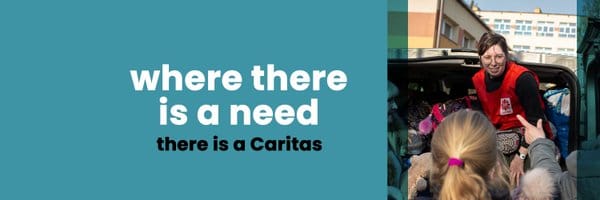
Where There Is a Need, There Is a Caritas
Caritas Europa uses a simple phrase:
Where there is a need, there is a Caritas.
The scale behind that statement is enormous.
But its meaning remains personal.
Someone is hungry.
Someone needs shelter.
Someone has fled war.
Someone is lonely.
Someone cannot find work.
Someone is ageing without adequate care.
Someone has crossed a border and doesn't know what comes next.
The European network exists so that the Catholic response to those realities doesn't remain isolated.
Experience can be shared.
Resources can move.
Organizations can strengthen one another.
Voices can become louder together.
And the struggles witnessed in one local community can reach institutions capable of changing the systems surrounding it.
At the heart of Caritas Europa is the Catholic conviction that every social issue eventually leads back to a human person whose dignity cannot be reduced to a statistic. Its 49 member organizations in 46 European countries work close to people experiencing poverty, displacement, exclusion, ageing, unemployment, homelessness, crisis, and other forms of vulnerability. Caritas Europa connects those local ministries into something larger—strengthening their humanitarian capacity, encouraging cooperation, studying the realities they encounter, and carrying their experience into European advocacy. It is where local charity meets continental solidarity: the person is helped nearby, the lessons travel across borders, and a Catholic network speaks together for a Europe in which nobody is pushed beyond the margins.


